
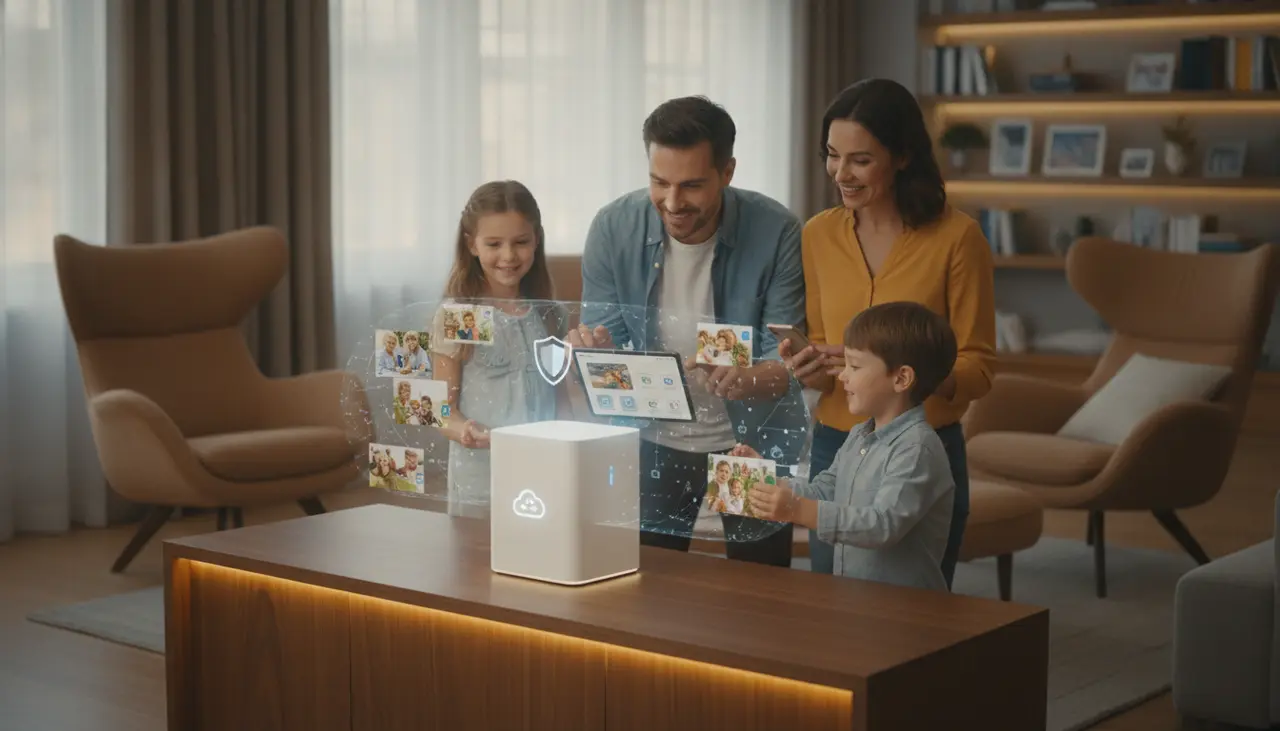
The Family Cloud Master Buying Guide: Secure Your Memories with a Private Home AI Server
We’ve all been there. You’re trying to capture a precious video of your toddler’s first steps or a high-school graduation, and that dreaded notification pops up: "Cloud Storage Full."
For most of us, the immediate reaction is to begrudgingly pay another $2.99 a month for more space. But lately, as parents, we're realizing the cost isn't just financial. It’s the nagging feeling that our family’s most private moments—the bath times, the messy kitchen dances, the sleepy morning snuggles—are being scanned, indexed, and used to train algorithms by big tech companies.
Welcome to The Family Cloud. This isn't about becoming a weekend IT professional; it’s about taking back the "digital keys" to your home. This master buying guide is designed to help you navigate the world of private, family-focused home AI server setup and management for privacy-conscious parents. We’re going to break down how to build a system that stores your photos, protects your privacy, and uses local AI to make your life easier—all without the data leaving your front door.
The Decision Framework: Why Go Local?
Before we look at the shiny hardware, let’s talk about why we’re doing this. A "Family Cloud" is essentially a small, quiet computer in your home that does everything Google Photos or iCloud does, but you own the hard drives.
The benefits are simple:
- Privacy: No corporate algorithms scanning your kids' faces.
- Speed: Accessing files over your home Wi-Fi is often faster than downloading from the internet.
- AI Power: Modern local AI can automatically organize your photos, recognize family members, and even help you search for "that time we went to the beach" without a single byte of data hitting a public server.
- Cost: While there is an upfront hardware cost, you stop the "subscription creep" of monthly cloud fees.
Who Is This Guide For?
This guide is for the parent who values digital sovereignty but is short on time. You don't need a degree in computer science. You just need the desire to protect your family's digital legacy. Whether you want a "set it and forget it" box or a slightly more powerful system to run a local AI assistant, we have a path for you.
The Three Pillars of Your Family Cloud
To get your private, family-focused home AI server setup and management for privacy-conscious parents right, you need to focus on three main components.
1. The Storage (The Digital Attic)
This is usually a NAS (Network Attached Storage). Think of it as a box of hard drives that plugs into your router.
- What to look for: At least two "bays" (slots for hard drives). This allows for "mirroring," meaning if one drive fails, your family photos are still safe on the second one.
- Pro Tip: Look for systems that offer "one-click" app installs for photo management.
2. The Brain (The AI Processor)
If you want your server to do more than just hold files—like automatically tagging family members in photos or running a local AI chatbot to help organize your schedule—you need "Compute."
- Mini-PCs: These are tiny, power-efficient computers. They are often better at AI tasks than a standard NAS.
- GPUs: If you are serious about local AI, look for hardware with an integrated or dedicated graphics chip (GPU). This is the "muscle" that powers AI facial recognition.
3. The Software (The User Interface)
The hardware is the body, but the software is the soul. You want an interface that feels as easy to use as the apps on your phone. We focus on tools that offer private mobile syncing, so your photos move from your phone to your basement automatically.
Choosing Your Setup: Two Common Scenarios
Scenario A: The "Privacy First" Minimalist
- Goal: Securely store photos and documents with zero hassle.
- Hardware: A high-quality 2-bay or 4-bay NAS.
- Focus: Reliability and ease of setup. You can find detailed breakdowns of these systems in our [buying_guides.html](buying_guides.html) section.
Scenario B: The "AI-Powered" Household
- Goal: Use local AI to organize thousands of videos, run a private home assistant, and manage smart home devices without the cloud.
- Hardware: A Mini-PC paired with a dedicated storage unit.
- Focus: Processing power and "future-proofing." Check our [product_reviews.html](product_reviews.html) for the latest Mini-PCs that handle AI tasks without breaking a sweat.
Common Mistakes to Avoid
- Buying "Enterprise" Gear: You don't need a rack-mount server that sounds like a jet engine and eats electricity. Stick to "Home" or "SOHO" (Small Office/Home Office) equipment. It’s quieter and more energy-efficient.
- Ignoring the Backup "Rule of Three": Even with a home server, you should follow the 3-2-1 rule: 3 copies of your data, on 2 different media types, with 1 copy off-site (like an encrypted drive at a grandparent's house).
- Over-complicating the Network: You don't need professional-grade data center networking. A good quality mesh Wi-Fi system and a few Ethernet cables are usually plenty for a family setup.
Your "Family Cloud" Buying Checklist
Before you head over to our detailed reviews, keep this checklist handy:
- [ ] Capacity: How many years of photos do you have? (Aim for at least 4TB to start).
- [ ] Physical Space: Do you have a cool, dry place near your router to plug in your server?
- [ ] Noise Level: Will this be in a living room or a closet? (Look for "fanless" or "quiet" ratings).
- [ ] AI Needs: Do you want facial recognition? (Ensure your hardware choice has a modern processor or GPU).
- [ ] Budget: Remember to factor in the cost of the hard drives, which are often sold separately from the server "shell."
Next Steps on Your Journey
Building a private home server is one of the best gifts you can give your family's future. It’s about more than just tech; it’s about creating a safe digital home where your memories can live forever without being a product for someone else.
To dive deeper into specific hardware recommendations and see which units we recommend for different budget levels, visit our [buying_guides.html](buying_guides.html) page. If you’re ready to see how these devices perform in a real-world family environment, our [product_reviews.html](product_reviews.html) provide honest, parent-focused insights.
Setting up a private, family-focused home AI server setup and management for privacy-conscious parents doesn't have to be a headache. Take it one step at a time, and remember: you're building a digital legacy that belongs only to you.