
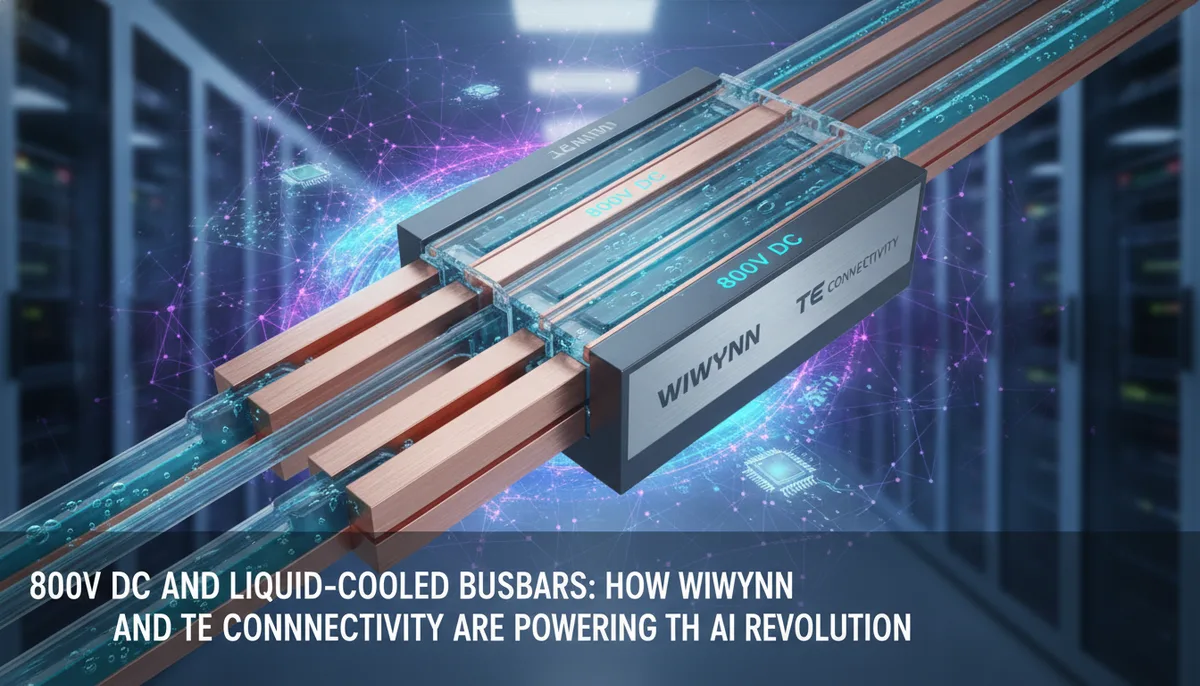
800V DC and Liquid-Cooled Busbars: How Wiwynn and TE Connectivity Are Powering the AI Revolution
The landscape of data center technology is shifting beneath our feet. At Computex 2026, the conversation has moved past simple CPU upgrades and into the realm of radical infrastructure overhauls. As AI accelerators—the "engines" of the modern world—grow in size and power consumption, the traditional ways we power and cool them are reaching their physical limits.
Wiwynn, a company known for showcasing technology that is consistently ahead of its time, recently pulled back the curtain on a collaboration with TE Connectivity. The reveal? A transition to 800V DC power distribution and, perhaps more surprisingly, the introduction of liquid-cooled busbars. This isn't just an incremental update; it is a fundamental redesign of how energy moves through a server rack.
The Power Density Crisis in the AI Era
To understand why 800V DC is becoming a necessity, we have to look at the sheer scale of modern AI hardware. We are no longer dealing with 300W or even 500W components. Next-generation AI accelerators are pushing toward a future where a single chassis might demand several kilowatts of power.
In a traditional 12V or even 48V DC system, delivering that much power requires massive amounts of current (Amperes). According to Ohm’s Law, heat loss in a conductor is proportional to the square of the current ($P = I^2R$). To keep cables from melting under the strain of high current, you would need incredibly thick copper busbars—so thick they would obstruct airflow and make the server impossible to service.
By jumping to 800V DC, the industry can deliver the same amount of power with significantly lower current. This allows for:
- Reduced Heat Generation: Lower current means less resistance-based heating within the power delivery system.
- Material Efficiency: Thinner copper conductors can be used, saving weight and cost.
- Higher Density: More accelerators can be packed into a single rack without the power delivery infrastructure becoming a physical bottleneck.
If you are following the evolution of high-end AI hardware, you might recognize these challenges from our look at The $125,000 Private AI Powerhouse: Inside the Supermicro GB300 Super AI Station, where power and cooling are the primary constraints on performance.
Liquid-Cooled Busbars: A Paradigm Shift
The Wiwynn booth at Computex 2026 showcased something truly unique: a busbar that is itself liquid-cooled. Historically, liquid cooling was reserved for the hottest components—CPUs and GPUs. However, at 800V and the power densities required for the next generation of AI, even the power distribution system becomes a significant heat source.
By integrating liquid cooling nozzles directly into the rear of the server node, Wiwynn and TE Connectivity are ensuring that the entire "power chain" remains thermally stable. In the demo, we saw a busbar connector that serves as the starting point for this power chain. This isn't just about preventing a fire; it’s about maintaining the efficiency of the power delivery. As conductors get hotter, their resistance increases, leading to even more power loss. Liquid cooling breaks this vicious cycle.
Anatomy of a Next-Gen Wiwynn Server Node
The mock-up displayed at the Wiwynn booth provided a directionally informative look at how these servers will be constructed. While it was a "dummy" unit in terms of active silicon, the physical layout revealed the industry's priorities.
The Front End: Storage and Management
At the front of the node, which follows the ORv3 (Open Rack v3) standard, we see a familiar but optimized layout:
- Management Module: Located on the far left for easy access.
- E1.S SSDs: Four high-speed E1.S form factor drives, which have become the standard for high-density AI data storage due to their superior thermal properties compared to traditional M.2 drives.
- Networking Cages: Centralized optical network cages designed for the massive throughput required to feed data to AI accelerators.
The Rear: Connectivity and Power
The rear of the node is where the real innovation happens. We see the integration of:
- Liquid Cooling Nozzles: For the scale-up networking and the internal cooling loops.
- 800V Busbar Connector: The centerpiece of the power delivery system.
- Scale-up Networking Connectors: Specialized ports that allow multiple nodes to act as a single, massive "super-accelerator" within the rack.
TE Connectivity’s "Drop-In" Power Solution
One of the most practical insights from the Wiwynn booth was the focus on manufacturability. As data centers scale, building these complex servers by hand becomes impossible. The industry is moving toward robotic assembly.
TE Connectivity showcased the HVDC IT GEAR TO ELCON MICRO+ Power Cable Assembly. This assembly features:
- An 800V/75A HVDC IT gear end.
- A 400V ELCON MICRO+ end.
- A total length and flexibility designed to "drop in" to the chassis during automated manufacturing.
Inside the server, this cable assembly runs down the center of the chassis, nestled between two massive dummy accelerator modules (each over 100cm²). This layout shows that power delivery is no longer an afterthought; it is the spine of the server. The entire assembly slots into a dedicated channel, ensuring that it doesn't interfere with the liquid cooling blocks that will eventually sit atop the accelerators.
What This Means for The Family Cloud and Private AI
While 800V DC power and liquid-cooled busbars might seem like "big tech" problems, these innovations have a direct impact on the future of private home AI. As we discuss in The Family Cloud Master Buying Guide: Secure Your Memories with a Private Home AI Server, the goal of a private cloud is to provide enterprise-grade privacy and performance in a home-friendly package.
- Trickle-Down Efficiency: The research into 800V DC and high-efficiency power delivery will eventually lead to more efficient Power Supply Units (PSUs) for prosumer hardware, reducing electricity bills for home server enthusiasts.
- Standardization of Liquid Cooling: As liquid cooling becomes mandatory for enterprise AI, the components (pumps, blocks, and quick-disconnect fittings) will become more standardized, cheaper, and more reliable for home users building their own private AI stations.
- Robotic Manufacturing: Better manufacturability at the enterprise level leads to lower costs for the hardware that eventually hits the secondary market, making high-powered AI nodes more accessible to "The Family Cloud" users.
If you are looking to start your own journey into private AI without waiting for 800V infrastructure, you can learn How to Setup Your Own Private 'Family ChatGPT' in 20 Minutes using today's accessible hardware.
The Road Ahead: 2026 and Beyond
The Wiwynn and TE Connectivity demo at Computex 2026 is a clear signal that the "easy" gains in data center performance are over. To push AI further, we have to rethink the physics of power.
The move to 800V DC is a bold step that requires new safety protocols, new connectors, and a new approach to thermal management. However, the benefits—higher density, better efficiency, and the ability to power the next generation of 100cm²+ accelerators—far outweigh the challenges.
As we continue to monitor the developments from Computex and beyond, it is clear that the future of data is not just about the code we write, but the copper and coolant that keep the lights on.