
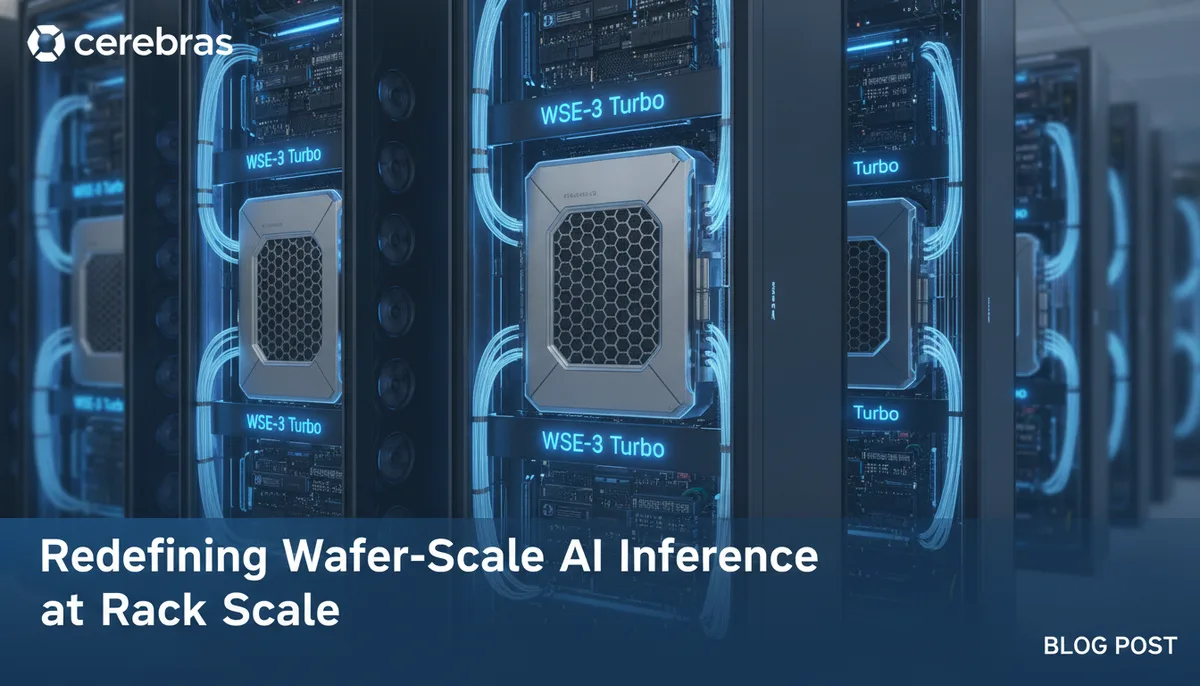
Cerebras CS-4 and WSE-3 Turbo: Redefining Wafer-Scale AI Inference at Rack Scale
The Evolution of Wafer-Scale Computing: Enter the CS-4
The landscape of artificial intelligence hardware is undergoing a seismic shift. For years, the industry has been dominated by the modular approach—linking thousands of relatively small GPUs together to form a cohesive "brain." Cerebras Systems has consistently challenged this paradigm with its Wafer-Scale Engine (WSE), and this week, they have taken their most significant step forward yet.
With the introduction of the WSE-3 Turbo processor and the CS-4 rack-scale AI inference system, Cerebras is moving beyond the "single box" solution. This launch marks the company's transition into providing full-scale data center infrastructure designed specifically to tackle the massive computational demands of modern Large Language Model (LLM) inference. As AI moves from the research lab into production, the bottleneck is no longer just how fast we can train a model, but how efficiently and quickly we can serve it to millions of users.
The WSE-3 Turbo: A Giant Leap in Silicon Engineering
At the heart of the new announcement is the WSE-3 Turbo. To understand why this matters, one must understand the sheer scale of Cerebras's engineering. While a standard high-end GPU is roughly the size of a postage stamp, the WSE-3 Turbo is the size of an entire silicon wafer.
Breaking the Reticle Limit
Traditional chip manufacturing is limited by the "reticle limit," which dictates the maximum size a single chip can be based on the equipment used to etch the circuits. Cerebras bypasses this by utilizing the entire wafer, creating a single, massive processor. This allows for:
- Massive Core Count: Hundreds of thousands of AI-optimized cores living on a single piece of silicon.
- On-Chip Memory: Gigabytes of SRAM directly on the wafer, providing memory bandwidth that is orders of magnitude faster than traditional HBM (High Bandwidth Memory) used in GPUs.
- Negligible Latency: Because the cores are physically connected on the same wafer, the "hop" between processing units takes nanoseconds rather than the microseconds required to travel across a PCB or a network cable.
The "Turbo" designation represents a refined iteration of their third-generation architecture, optimized for the clock speeds and power delivery required for sustained inference workloads. This is critical as the industry shifts its focus toward AMD Instinct MI350P Deep Dive: The CDNA 4 Powerhouse Redefining PCIe AI Accelerators and other high-performance competitors.
The CS-4: From Component to Rack-Scale System
The most significant part of this week's news isn't just the chip; it’s the system it lives in. The Cerebras CS-4 is the company’s first true rack-scale AI inference system. Historically, a Cerebras system was a 15U "supercomputer in a box." While powerful, integrating these into standard data center environments required specialized considerations.
Why Rack-Scale Matters
The CS-4 evolves this concept into a holistic rack-scale architecture. By moving to a rack-scale design, Cerebras can better manage the extreme power and cooling requirements of a wafer-scale engine while providing a more "plug-and-play" experience for enterprise customers.
In a world where data centers are struggling to find enough power for traditional GPU clusters, the CS-4 aims to provide more "compute per square foot" than almost any other solution on the market. This density is achieved by eliminating the "tax" of networking equipment, external memory controllers, and the complex cabling required to link thousands of discrete GPUs.
APC NetShelter SX Deep Depth Rack Enclosure
Solving the Inference Bottleneck
As LLMs like GPT-4, Llama 3, and Claude become integrated into everyday applications, the cost of "inference" (running the model) is skyrocketing. Traditional GPU architectures often struggle with "memory wall" issues—the processor is faster than the memory can feed it data.
Throughput vs. Latency
In the world of AI inference, there are two primary metrics:
- Throughput: How many total queries can the system handle at once?
- Latency: How fast does a single user get their answer?
Traditional GPU clusters are excellent at throughput but can struggle with latency for very large models because the model must be split across many chips. The communication between these chips creates a "latency floor." Because the Cerebras CS-4 can often fit an entire model (or a significant portion of it) on a single wafer, it can achieve ultra-low latency that is virtually impossible for traditional distributed systems.
This makes the CS-4 particularly attractive for real-time AI applications, such as high-frequency trading, real-time voice translation, and interactive AI agents where a delay of even a few hundred milliseconds can ruin the user experience.
Comparing the Landscape: Cerebras vs. The Field
Cerebras isn't operating in a vacuum. The competition for AI dominance is fiercer than ever. While Cerebras focuses on wafer-scale integration, other players are pushing the limits of the modular approach.
For instance, NVIDIA continues to dominate with its Blackwell architecture, focusing on massive HBM3e integration and NVLink interconnects. Meanwhile, we are seeing specialized edge solutions like those discussed in our look at how NVIDIA Expands Jetson Thor Lineup: Meet the T3000 and T2000 Mid-Range Modules.
The CS-4's advantage lies in its simplicity of programming. In a GPU cluster, developers must spend significant time optimizing "model parallelism"—deciding which part of the model goes on which chip. On a CS-4, the wafer appears to the software as a single, giant processor, drastically reducing the complexity of deploying large-scale models.
The "Family Cloud" Perspective: Why This Matters for Private AI
While the Cerebras CS-4 is an enterprise-grade system costing millions of dollars, its existence signals a broader trend that affects the "Family Cloud" ecosystem. The innovations happening at the rack-scale level eventually trickle down to the consumer and prosumer markets.
The focus on inference efficiency is exactly what home users need when trying to run local LLMs for privacy and security. As enterprise hardware becomes more efficient at running large models, the software optimizations developed for these systems eventually find their way into the open-source community, allowing smaller, more efficient models to run on home hardware.
If you are looking to build your own localized version of an AI powerhouse—albeit on a much smaller scale—you should check out The Family Cloud Master Buying Guide: Secure Your Memories with a Private Home AI Server. Understanding the architecture of giants like Cerebras helps us understand the direction of local AI: more on-chip memory and tighter integration.
ASUS Pro WS WRX90E-SAGE SE WIFI Workstation Motherboard
Deployment and Scalability: The Data Center Impact
The CS-4 is designed to be the backbone of the next generation of AI clouds. By offering a rack-scale system, Cerebras is targeting:
- Hyperscalers: Who need to deploy massive amounts of inference power quickly.
- Sovereign AI Clouds: Nations looking to build their own AI infrastructure independent of traditional supply chains.
- Enterprise Labs: Companies that want to keep their proprietary data in-house rather than sending it to public API providers.
The integration of the WSE-3 Turbo into a rack-scale format also simplifies the cooling challenges. Wafer-scale chips generate an immense amount of heat in a very concentrated area. The CS-4 uses advanced liquid cooling manifolds to ensure that the WSE-3 Turbo can maintain its "Turbo" clock speeds without thermal throttling, a feat of mechanical engineering as much as silicon design.
Conclusion: A New Era for AI Infrastructure
The launch of the Cerebras CS-4 and the WSE-3 Turbo processor represents a maturing of the wafer-scale industry. It is no longer just a fascinating laboratory experiment; it is a production-ready, rack-scale solution for the most demanding AI workloads on the planet.
By focusing on the specific needs of inference—latency, memory bandwidth, and ease of deployment—Cerebras is positioning itself as a vital alternative to the traditional GPU-centric data center. Whether you are an enterprise architect or a hardware enthusiast, the CS-4 is a clear indicator that the future of AI will be defined by those who can successfully break the limits of traditional silicon.
For those interested in how high-density server design is evolving in other sectors, such as the latest in AMD EPYC deployments, stay tuned to our deep dives into the changing face of the modern data center.
Mellanox ConnectX-7 400G Network Interface Card