
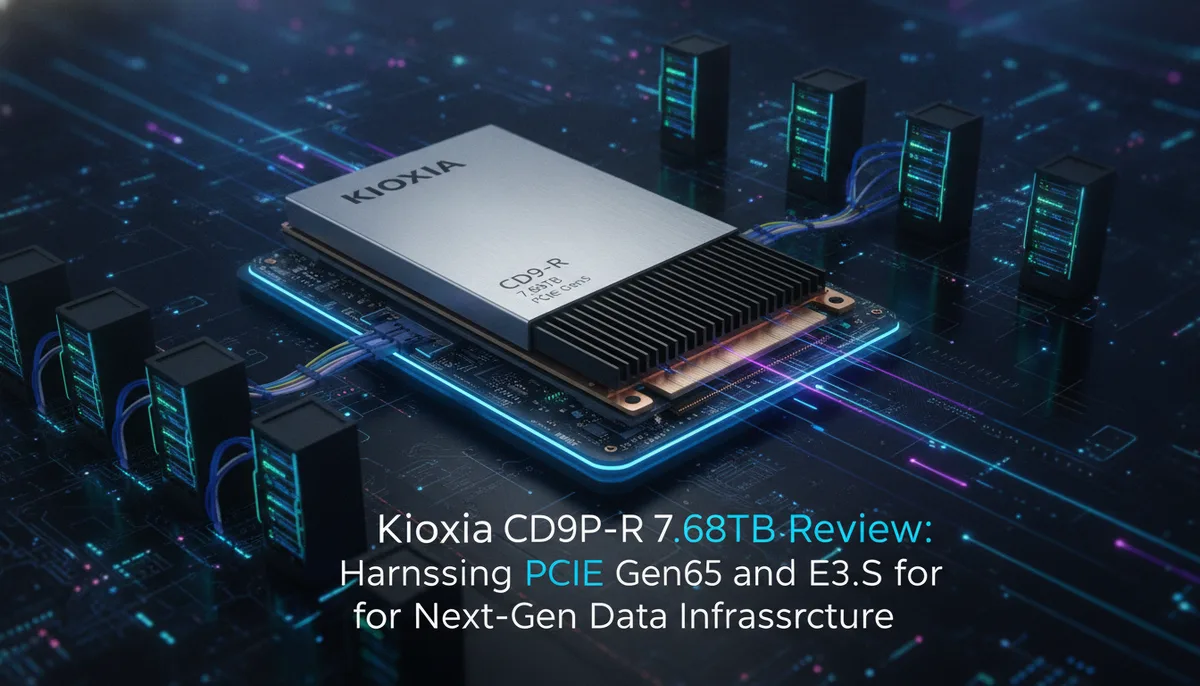
Kioxia CD9P-R 7.68TB Review: Harnessing PCIe Gen5 and E3.S for Next-Gen Data Infrastructure
The landscape of enterprise storage is undergoing its most significant architectural shift in a decade. As we transition from PCIe Gen4 to Gen5, the physical limitations of legacy hardware are becoming apparent. Enter the Kioxia CD9P, the company’s latest family of data center SSDs designed to bridge the gap between current density requirements and the extreme throughput of the Gen5 era.
Specifically, we are looking at the Kioxia CD9P-R 7.68TB model in the E3.S form factor. This drive represents a departure from the traditional U.2 drives that have dominated the server market for years, signaling a broader move toward EDSFF (Enterprise and Data Center SSD Form Factor) standards.
The Shift to EDSFF: Why E3.S Matters
The first thing any hardware enthusiast will notice about the CD9P is its physical profile. This is not a standard 2.5-inch U.2 drive. Instead, it utilizes the E3.S form factor. While U.2 has served the industry well, its connector was originally designed with SAS/SATA compatibility in mind. As interface speeds double with each PCIe generation, the "legacy" baggage of the U.2 connector creates challenges for signal integrity and thermal management.
The E3.S form factor allows for much higher storage density. In modern 1U servers, such as those discussed in our MSI’s Next-Gen AMD EPYC Venice Server: A Deep Dive into DLC and High-Density Performance coverage, the thin profile of E3.S allows for more drives to be packed into the same horizontal space.
Improved Cooling and Signal Integrity
The E3.S connector is physically smaller than its U.2 predecessor. This reduction in size isn't just about making things "smaller"; it’s about airflow. By reducing the footprint of the connector and the drive tray, server manufacturers can improve the thermal path across the motherboard and through the drive cage. Furthermore, the E3.S interface is optimized for the high-frequency signals required by PCIe Gen5 and the upcoming Gen6, where the older U.2 standard begins to struggle with electrical interference.
Under the Hood: BiCS 8 NAND and Gen5 Performance
The Kioxia CD9P-R is powered by the company’s BiCS 8 NAND technology. This latest generation of 3D NAND is designed to provide the high bit density required for modern data centers while maintaining the performance levels needed to saturate a PCIe Gen5 x4 link.
Performance Specifications
The "R" in CD9P-R stands for "Read-Intensive." This model is rated for 1 Drive Write Per Day (DWPD) over a five-year period. If your workload involves heavy database writes or constant logging, Kioxia offers the "CD9P-V" mixed-use variant, which steps up to 3 DWPD but sacrifices some raw capacity (6.4TB vs 7.68TB) to accommodate more over-provisioning.
For the 7.68TB model, the performance figures are staggering:
- Sequential Read: Up to 14.8GB/s
- Sequential Write: Up to 7GB/s
- Random Read (4K): Up to 2.6 million IOPS
- Random Write (4K): Up to 450,000 IOPS
These speeds are essential for modern AI training environments and high-speed data ingestion. If you are building a private cloud to manage large-scale media libraries or local AI models, as outlined in The Family Cloud Master Buying Guide: Secure Your Memories with a Private Home AI Server, the ability to pull data at nearly 15GB/s ensures that the storage layer is never the bottleneck.
Kioxia CD9P-R NVMe SSD
Capacity Dynamics: E3.S vs. U.2
One interesting nuance of the CD9P family is how capacity scales with the form factor. While the E3.S version we are examining tops out at 30.72TB, the 15mm U.2 version of the same drive can reach up to 61.44TB.
The reason for this is purely physical volume. The 15mm U.2 drive has significantly more internal space for NAND package placement than the thinner E3.S variant. However, the industry trend is moving toward the E3.S form factor because the density benefits of fitting more drives into a chassis often outweigh the raw capacity of a single larger drive.
For most high-end home servers or small business deployments, the 7.68TB capacity of our review unit hits the "sweet spot" for price-to-performance, especially when configured in a RAID or ZFS pool.
The End of U.2 and the Future of Gen6
Kioxia’s release of the CD9P marks a turning point. It is likely one of the last generations of drives that will be offered in both U.2 and EDSFF form factors. As we look toward PCIe Gen6, the electrical requirements are becoming so stringent that the U.2 connector may finally be retired in favor of the superior signal integrity of EDSFF.
By adopting E3.S now, Kioxia is positioning the CD9P as a future-proof solution for data centers that are currently transitioning their infrastructure. This move mirrors the evolution we see in the compute space, where modularity and high-density interconnects are becoming the standard for AI-driven workloads.
PCIe Gen5 E3.S SSD Carrier
Practical Use Cases for the CD9P-R
While the CD9P-R is technically a "Data Center" drive, its features make it highly attractive for "Prosumer" and "Family Cloud" applications where reliability is paramount.
1. High-Speed Media Streaming and Editing
For those running a home media server (like Plex or Jellyfin) with 4K or 8K content, the 14.8GB/s read speed allows for instantaneous seeking and the ability to serve dozens of concurrent streams without breaking a sweat.
2. Local AI Model Hosting
With the rise of Large Language Models (LLMs) and image generation tools, having fast storage is critical for loading model weights into VRAM. A Gen5 drive like the CD9P-R can feed high-end GPUs significantly faster than Gen4 alternatives, reducing startup times for AI applications.
3. Virtualization and Containers
If you run multiple Virtual Machines (VMs) or a heavy Docker environment, the 2.6 million random read IOPS ensure that boot times and application responsiveness remain snappy, even when multiple services are accessing the disk simultaneously.
Final Thoughts: A New Standard for Performance
The Kioxia CD9P-R 7.68TB E3.S SSD is more than just a speed bump; it is a showcase of the next generation of storage architecture. By combining the throughput of PCIe Gen5 with the density and thermal advantages of the E3.S form factor, Kioxia has delivered a drive that is ready for the most demanding modern workloads.
While the transition to E3.S may require new server backplanes or specialized adapters for home users, the performance gains and long-term reliability of BiCS 8 NAND make it a compelling choice for anyone looking to build a truly high-performance data infrastructure.
Kioxia Enterprise SSD 7.68TB