
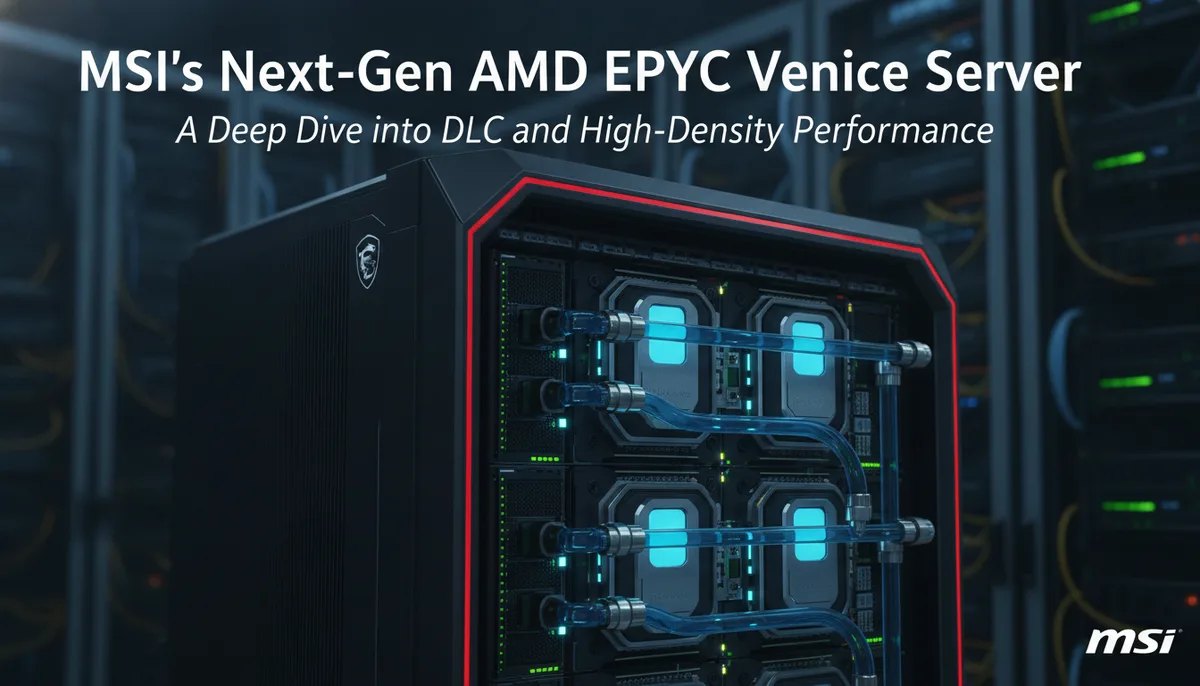
MSI’s Next-Gen AMD EPYC Venice Server: A Deep Dive into DLC and High-Density Performance
The landscape of enterprise computing is shifting beneath our feet. As artificial intelligence and massive data processing become the standard rather than the exception, the hardware required to sustain these workloads is undergoing a radical transformation. At Computex, one of the most intriguing "sly" reveals came from MSI, showcasing their upcoming CD182-S6091-X2 server node.
This isn't just another incremental update; it is a dedicated platform for the AMD EPYC Venice series—the Zen 6 architecture that promises to redefine what we expect from x86 server performance. By integrating Direct Liquid Cooling (DLC) into a high-density 1OU2N form factor, MSI is signaling a future where power and efficiency are no longer at odds.
The Architecture of Density: Understanding the 1OU2N Form Factor
To appreciate the MSI CD182-S6091-X2, one must first understand the constraints of the modern data center. Space is at a premium, and "density" is the name of the game. The CD182-S6091-X2 utilizes a 1OU2N design.
In standard rack terminology, an "OU" (Open Unit) is the Open Compute Project’s (OCP) equivalent to the traditional Rack Unit (U), though slightly taller (48mm vs 44.45mm). The "2N" signifies that two independent server nodes are crammed into that single unit of height.
Dual-Socket Power in Every Node
What makes the MSI reveal particularly impressive is that each of these two nodes is a dual-socket configuration. In a single 1OU space, you are looking at four AMD EPYC Venice CPUs. If Venice follows the trajectory of its predecessors, we could be looking at hundreds of cores and thousands of threads in just a few inches of vertical rack space.
This level of density is critical for organizations building out private clouds or intensive AI training clusters. For those looking to scale their own infrastructure, understanding these hardware leaps is essential, as detailed in The Family Cloud Master Buying Guide: Secure Your Memories with a Private Home AI Server.
AMD EPYC Venice: The Zen 6 Leap
While AMD’s "Turin" (Zen 5) is the immediate focus for many, "Venice" (Zen 6) is the horizon line the industry is watching. Venice is expected to utilize the SP7 socket, a transition necessitated by the increased power delivery and I/O requirements of the next-generation architecture.
Expected Advancements in Venice
- Increased Core Counts: While Turin already pushes the envelope, Venice is rumored to leverage advanced packaging techniques to increase core density even further.
- Memory Bandwidth: With the move to SP7, we expect to see support for faster DDR5 (or even DDR6) speeds and potentially more memory channels to feed the massive core counts.
- PCIe Gen 6 Readiness: As AI accelerators demand more bandwidth, Venice is positioned to be the backbone for the next generation of GPUs and NVMe storage.
The MSI CD182-S6091-X2 is built specifically to handle these advancements. By showing off the board now, MSI is proving that the physical infrastructure—the power delivery phases and the thermal management—is already being perfected for Zen 6.
The Necessity of Direct Liquid Cooling (DLC)
The most striking feature of the MSI CD182-S6091-X2 is its cooling solution. As TDPs (Thermal Design Power) for flagship server CPUs climb toward 400W, 500W, and beyond, air cooling reaches a physical limit.
How MSI's DLC Works
The CD182-S6091-X2 employs a cold-plate system that sits directly atop the Venice CPUs. Instead of massive heatsinks and high-RPM fans that consume significant "parasitic" power, liquid is circulated through the plates to carry heat away to a Manifold or a Heat Distribution Unit (HDU).
Benefits of DLC in the CD182-S6091-X2:
- Thermal Stability: Liquid can absorb significantly more heat than air, preventing the thermal throttling that can plague high-density air-cooled nodes.
- Energy Efficiency: By reducing the reliance on massive chassis fans, data centers can lower their PUE (Power Usage Effectiveness) scores.
- Acoustic Reduction: While less a concern in a data center, the reduction in high-pitched fan noise is a byproduct of efficient liquid loops.
For those integrating high-performance accelerators, such as the ones discussed in our AMD Instinct MI350P Deep Dive: The CDNA 4 Powerhouse Redefining PCIe AI Accelerators, managing the combined heat of CPUs and GPUs makes DLC almost mandatory.
Infrastructure and Implementation: The MSI Rack Solution
MSI didn't just show the node; they showed the rack. The CD182-S6091-X2 is part of a broader ecosystem that includes specialized racks equipped with liquid manifolds.
The Plumbing of Progress
In the MSI setup, the rear of the rack features quick-disconnect valves. This allows administrators to slide a node out for maintenance without draining the entire system or risking leaks. This "blind-mate" connectivity is the gold standard for enterprise liquid cooling.
For a business or a high-end "Family Cloud" enthusiast, this represents a shift in how we think about server maintenance. It requires a facility—or at least a dedicated space—that can handle liquid distribution.
Why Venice Matters for Private AI and Data Sovereignty
You might wonder why a dual-socket Venice node is relevant to the average professional or the "Family Cloud" philosophy. The answer lies in Data Sovereignty.
As public AI models become more restrictive and expensive, the value of running local, massive-scale LLMs (Large Language Models) grows. A Venice-based platform provides the compute "headroom" to run local AI that can index every photo, document, and video a family or a small business produces without ever sending that data to a third-party cloud.
The MSI CD182-S6091-X2 represents the "prosumer" ceiling. While most will start with single-socket systems, the innovations in Venice (Zen 6) will eventually trickle down into the workstations and high-end desktops we use daily.
Comparing Venice to the Current State of the Art
To understand where we are going, we have to look at where we are. Currently, AMD EPYC Genoa and Bergamo (Zen 4) dominate the high-core-count market. Turin (Zen 5) is the iterative step forward. Venice (Zen 6), however, is being viewed as a "clean sheet" approach in several key architectural areas.
| Feature | EPYC Genoa (Zen 4) | EPYC Venice (Zen 6) |
|---|---|---|
| Socket | SP5 | SP7 |
| Cooling | Air/Liquid Optional | DLC Recommended for Density |
| Architecture | 5nm/6nm | Likely 3nm/2nm process |
| Primary Focus | General Compute/Cloud | AI-Inference/Extreme Density |
MSI’s decision to showcase the CD182-S6091-X2 so early suggests that the transition to SP7 and Zen 6 will be one of the most significant hardware shifts in the last decade of server history.
Final Thoughts: Preparing for the Venice Wave
The MSI CD182-S6091-X2 is more than just a piece of hardware; it’s a roadmap. It tells us that the future of high-performance computing is liquid-cooled, incredibly dense, and powered by AMD’s Zen 6 architecture.
For IT professionals and hardware enthusiasts, the takeaway is clear: start planning for liquid infrastructure now. Whether you are managing a corporate data center or building the ultimate private AI server for your home, the thermal and power requirements of the next generation will require a new approach to system design.
The "sly" reveal at Computex was a wake-up call. The Venice era is coming, and MSI is ready to house it.