
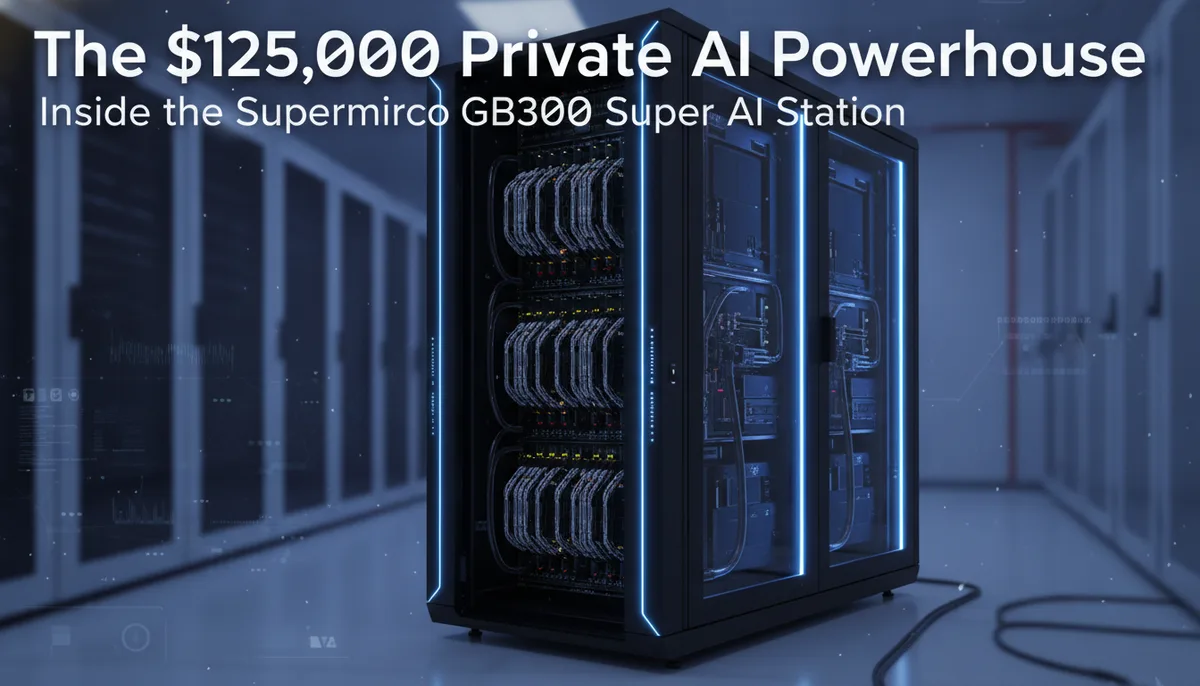
The $125,000 Private AI Powerhouse: Inside the Supermicro GB300 Super AI Station
At Computex 2026, the tech world caught a glimpse of the absolute ceiling of desktop computing. While most consumers are focused on the next generation of laptops or gaming rigs, a specific class of "super-workstations" is emerging to handle the massive demands of local Artificial Intelligence. Leading this charge is the Supermicro Super AI Station, a machine that brings NVIDIA’s flagship GB300 Grace Blackwell architecture out of the data center and into the office—provided you have $125,000 to spare.
For those of us at The Family Cloud, this machine represents the "North Star" of private AI. While most families will opt for more modest setups, understanding the Super AI Station helps us see where home-based, private AI is heading. It is the ultimate expression of the "Local AI" movement: keeping your data, your models, and your processing power within your own four walls.
The Heart of the Beast: The NVIDIA GB300 Grace Blackwell
The Supermicro Super AI Station is built around the NVIDIA GB300, a "superchip" that combines two distinct worlds into a single piece of silicon. Unlike traditional desktops that have a separate CPU and GPU connected via a motherboard, the GB300 utilizes NVIDIA’s high-speed interconnects to fuse a 72-core Grace CPU with a Blackwell GPU.
This isn't just a minor upgrade; it is a fundamental shift in how computers process information. The Blackwell architecture is designed specifically for the era of Generative AI, capable of running massive Large Language Models (LLMs) that would choke even the highest-end consumer gaming cards.
However, there is a catch for the desktop version. To keep the 1600-watt thermal envelope manageable in a workstation form factor, NVIDIA uses a "de-rated" version of the Blackwell GPU. The chip features seven of its eight HBM3e stacks enabled, providing a staggering 252GB of GPU memory and a memory bandwidth of 7.1TB/second. For context, that is enough memory to run the world's most advanced AI models entirely locally, without ever sending a single byte of data to the cloud.
Engineering for 1600 Watts: Cooling and Design
One does not simply plug a 1600-watt machine into a standard power strip and call it a day. The Supermicro Super AI Station requires industrial-grade engineering to prevent it from melting under its own processing heat.
Supermicro’s solution, showcased behind a plexiglass panel at Computex, is a sophisticated liquid cooling loop. Cold plates cover every critical component, including the GB300 chip and the specialized SOCAMMs (Compression Attached Memory Modules). The heat is then carried away to a massive front-mounted radiator.
Front-to-Back Airflow
The system utilizes a front-to-back airflow configuration. Three high-static-pressure fans pull air through the radiator at the front, pushing it across the internal components and out the rear. This design serves two purposes:
- Acoustics: It allows the system to remain relatively quiet compared to a screaming server rack, making it suitable for an office or a high-end home lab.
- Versatility: This configuration allows the Super AI Station to be converted into a 5U rackmount server. While it is a "desktop" first, it can easily transition into a professional server closet.
Memory and Storage: Speed Without Bottlenecks
In the world of AI, memory bandwidth is often more important than raw clock speed. If the processor can't get data fast enough, it sits idle. The Super AI Station addresses this with 496GB of LPDDR5X memory dedicated to the Grace CPU. This memory is housed in four SOCAMMs, which are technically removable but are tucked under the liquid cooling blocks, making upgrades a task for the brave.
On the storage side, Supermicro has equipped the station with four PCIe Gen5 x4 M.2 2280 slots. In the showcase model, these were filled with Micron 7450 Gen4 drives, though the system supports the even faster Gen5 standard.
For users looking to build a massive local database of family photos, videos, and documents for their AI to "read" and organize, this level of storage throughput ensures that the AI can index terabytes of data in minutes rather than hours. If you are just starting your journey into local data management, you might find our The Family Cloud Master Buying Guide: Secure Your Memories with a Private Home AI Server a more accessible entry point.
The Graphics Paradox: Why You Need an Extra GPU
Perhaps the most surprising aspect of the Super AI Station is that, despite being a $125,000 computer, it cannot actually "display" an image on a monitor out of the box.
The GB300 is a compute-optimized chip. It is a "brain" designed for math, not a "painter" designed for pixels. To use this as a workstation, you must utilize one of the available PCIe x16 slots to install an NVIDIA RTX PRO video card. This card handles the actual graphics output to your monitors, while the GB300 sits in the background doing the heavy lifting for AI tasks.
This separation of concerns is common in the enterprise world but can be a shock to desktop users. It highlights the specialized nature of this machine: it is a tool for creators, researchers, and "prosumers" who are building the next generation of private AI applications.
Networking: 400GbE and the Future of the Home Lab
The Super AI Station features dual 400GbE QSFP ports powered by NVIDIA’s ConnectX-8. To put that in perspective, most modern homes have 1GbE or perhaps 10GbE networking. A 400Gb connection is 40 times faster than the fastest consumer-grade networking currently available.
Why would a desktop need this much bandwidth?
- Clustering: It allows multiple Super AI Stations to be linked together to act as a single, massive supercomputer.
- Data Backhaul: It enables lightning-fast communication between the station and a primary storage server (NAS), which is essential when training AI models on petabytes of family data or high-resolution video archives.
While most of us don't need 400GbE today, the inclusion of this technology shows that the bottleneck for AI is moving away from the processor and toward the "pipes" that carry the data.
Why This Matters for The Family Cloud
You might be wondering why a site dedicated to "The Family Cloud" is covering a $125,000 enterprise workstation. The answer lies in the "Trickle-Down" effect of technology.
The Grace Blackwell architecture represents the ultimate privacy tool. When you run an AI model on a GB300, your data never leaves your house. There are no "Terms of Service" that allow a corporation to train their models on your family photos. There is no risk of a cloud provider being hacked and leaking your private conversations.
As this technology matures, the features we see in the Super AI Station today—integrated high-speed memory, massive local LLM capacity, and liquid-cooled efficiency—will eventually find their way into more affordable home servers.
If you want to experience a slice of this future today without the six-figure price tag, you can learn How to Setup Your Own Private 'Family ChatGPT' in 20 Minutes using much more modest hardware.
Conclusion: The Ultimate Investment in Digital Sovereignty
The Supermicro Super AI Station is a glimpse into a future where the most powerful computers in the world sit on our desks rather than in a distant data center. It is a machine designed for the "sovereign individual"—someone who wants the power of the world's best AI without the privacy compromises of the cloud.
While the $125,000 price tag makes it a rare sight in home offices, its existence proves that the hardware to support a truly private, hyper-intelligent digital life is here. Whether you are a developer building the next big AI app or a privacy advocate looking for the ultimate way to secure your memories with a private home AI server, the Super AI Station is the gold standard of what is possible when we bring the power of the cloud home.