
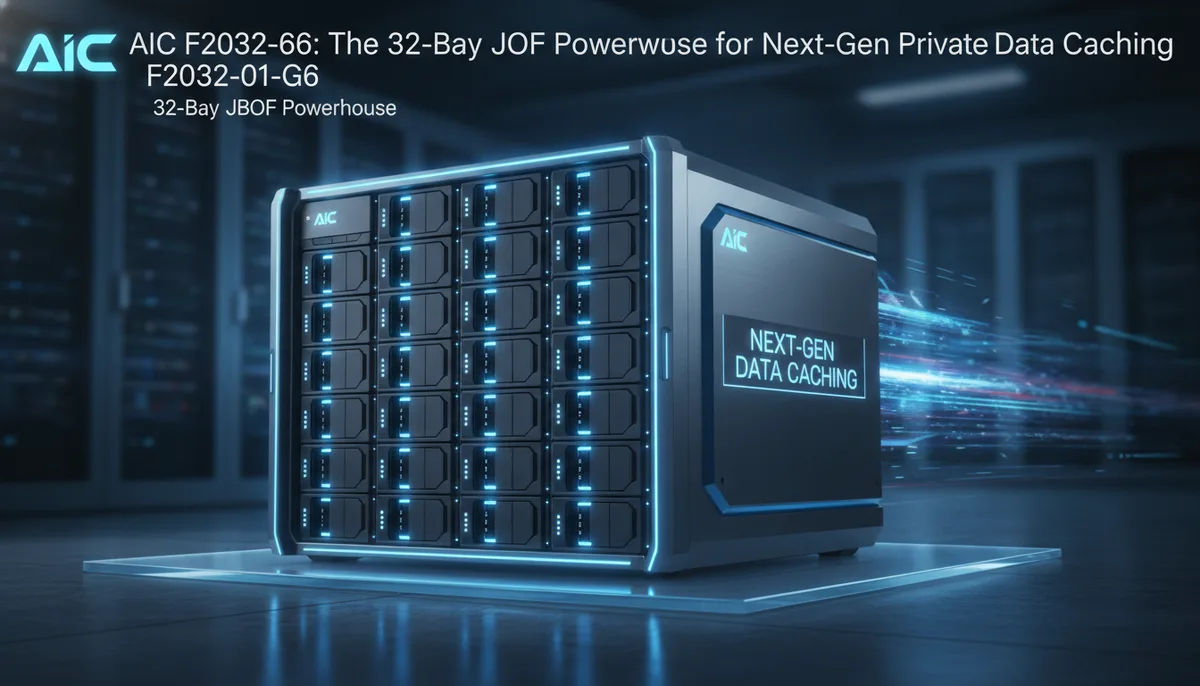
AIC F2032-01-G6: The 32-Bay JBOF Powerhouse for Next-Gen Private Data Caching
The landscape of data storage is shifting from simple "cold" archival to "intelligent" active caching. As we move closer to the "Rubin Vera" era—NVIDIA’s next-generation architecture—the hardware required to manage massive datasets is becoming more specialized. AIC is leading this charge with the introduction of the F2032-01-G6, a 2U JBOF (Just a Bunch of Flash) storage system that packs 32 E3 SSD bays into a compact footprint.
Designed to function as a high-performance key-value caching appliance, this system isn't just about raw capacity; it’s about the speed of access. For those building the ultimate private data infrastructure, understanding how these enterprise-grade advancements trickle down into the "Family Cloud" is essential for future-proofing your digital legacy.
Understanding the AIC F2032-01-G6 Architecture
The AIC F2032-01-G6 is a 2U rackmount chassis that prioritizes density and throughput. In the world of enterprise storage, a JBOF serves as a specialized enclosure that decouples storage from compute. By housing 32 E3 SSDs, AIC provides a path toward petabyte-scale flash storage in a remarkably small amount of rack space.
What sets the F2032-01-G6 apart is its preparation for the PCIe Gen6 era. While many home users are still transitioning to PCIe Gen4 or Gen5, the industry is already looking toward the massive bandwidth of Gen6 to handle the telemetry and data processing requirements of modern AI. This system is built to ensure that the storage medium is never the bottleneck in a high-speed network.
The Shift to E3 SSDs and PCIe Gen6
For years, the U.2 and M.2 form factors have dominated the NVMe market. However, as we push toward higher speeds, these older designs face thermal and signal integrity challenges. The E3 (EDSFF) form factor used in the AIC F2032-01-G6 is the industry's answer to these problems.
E3 SSDs are designed with a larger surface area for cooling and a connector optimized for the high-frequency signals of PCIe Gen5 and Gen6. This transition is critical because, as we discussed in our look at how Micron 9650: How PCIe Gen6 SSDs are Redefining the Speed of AI and Private Data, the jump in throughput requires hardware that can stay cool under the pressure of constant data ingestion.
By utilizing 32 of these drives, the AIC F2032-01-G6 can deliver millions of IOPS (Input/Output Operations Per Second), making it ideal for environments where thousands of small files—like a family's decade-long photo library—need to be indexed and searched instantly.
BlueField-4 DPUs: The "Brain" of Modern JBOFs
A storage box with 32 high-speed SSDs would typically overwhelm a standard CPU if it had to manage all the networking and data routing. This is where the NVIDIA BlueField-4 DPU (Data Processing Unit) comes into play. The AIC F2032-01-G6 is designed to be paired with these DPUs to offload critical tasks.
The DPU acts as a "computer in front of the computer." It handles:
- NVMe-over-Fabrics (NVMe-oF): Allowing the storage to act as if it is locally attached to any server on the network.
- Encryption and Decryption: Ensuring data is secure at rest and in transit without slowing down the main processor.
- Compression: Maximizing the efficiency of the 32 SSD bays.
In the context of a high-end home AI server, using a DPU-enabled JBOF means your AI models can pull data from the storage array at near-memory speeds, facilitating real-time facial recognition or natural language processing across your private documents.
Why Key-Value Caching Matters for Your Private Cloud
AIC is positioning the F2032-01-G6 specifically as a key-value caching appliance. To understand why this is a game-changer, we have to look at how data is typically stored. Most systems use a file system that requires navigating a "tree" of folders and metadata. Key-value storage, however, uses a simple "key" (like a unique ID) to instantly retrieve a "value" (the data).
When you are searching through 15 years of family memories, a key-value cache allows the system to find specific metadata—like "Photos of Mom in Italy"—in milliseconds. Instead of the server spinning up disks or searching through slow indexes, the AIC system keeps these "keys" in its massive 32-bay flash array.
This technology is a cornerstone of what we discuss in The Family Cloud Master Buying Guide: Secure Your Memories with a Private Home AI Server. As private AI becomes more prevalent, the ability to cache and retrieve data instantly will be the difference between a seamless experience and a frustratingly slow one.
From Enterprise to Prosumer: The Rubin Vera Era
The mention of the "Rubin Vera" era is significant. NVIDIA's Rubin architecture represents the next leap in AI computing, following the Blackwell generation. These systems will require unprecedented data feeding speeds. AIC’s F2032-01-G6 is essentially the "gas station" for these high-performance AI "engines."
While the average household might not need 32 E3 SSDs today, the technologies pioneered here—such as DPU offloading and EDSFF form factors—are already starting to appear in prosumer hardware. Building a home server today with an eye toward these standards ensures that your data remains accessible as AI applications become more demanding.
Choosing the Right Foundation for Your Family Data
While the AIC F2032-01-G6 is an enterprise powerhouse, it serves as a blueprint for high-availability storage. If you are looking to secure your family's digital life, you need a balance of capacity and speed.
For most users, a full 32-bay JBOF might be overkill, but the principle of using high-speed flash for caching is universal. You can see how these concepts apply to more accessible hardware in our guide on the Best Home Servers for Storing 10 Years of Family Photos (and Keeping Them Private). Whether you are using a 4-bay NAS or a 32-bay enterprise rack, the goal remains the same: ensuring your data is safe, private, and instantly available.
Technical Specifications Summary
For those looking at the hardware details, the AIC F2032-01-G6 offers:
- Chassis: 2U Rackmount.
- Drive Support: 32 x E3.S (EDSFF) SSDs.
- Connectivity: Optimized for BlueField-4 DPUs and PCIe Gen6 throughput.
- Primary Use Case: Key-value caching, AI data feeding, and high-frequency trading environments.
Final Thoughts: The Future of Flash
The AIC F2032-01-G6 is a glimpse into a future where storage is no longer a passive repository but an active, intelligent participant in data processing. By combining the density of 32 E3 SSDs with the processing power of the BlueField-4 DPU, AIC has created a machine capable of keeping up with the next generation of AI.
As we continue to generate more data than ever before—from 4K family videos to AI-generated content—the need for high-speed caching appliances will only grow. Investing in the right architecture today means your family cloud will be ready for the Rubin Vera era and beyond.