
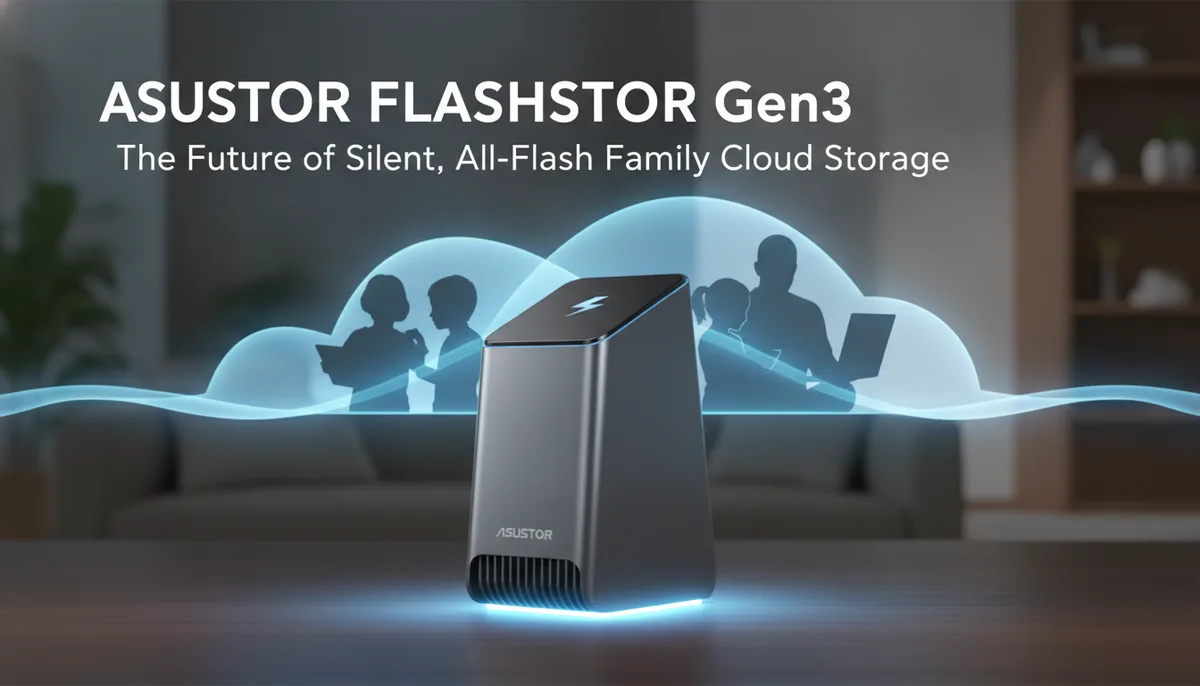
Asustor Flashstor Gen3: The Future of Silent, All-Flash Family Cloud Storage
The landscape of home data storage is undergoing a seismic shift. For decades, the "Family Cloud" was synonymous with bulky, vibrating boxes filled with spinning platters. But at Computex 2026, Asustor signaled that the era of the mechanical hard drive is rapidly drawing to a close for enthusiasts and families alike.
The unveiling of the Asustor Flashstor 6 Gen3 and the Flashstor 12 Pro Gen3 marks a pivotal moment in the evolution of the Network Attached Storage (NAS). These aren't just incremental updates; they represent a commitment to the "All-Flash" lifestyle—where speed, silence, and compact design take center stage. For families looking to secure their digital legacy, these devices offer a glimpse into a future where the home server is as sleek and unobtrusive as a gaming console.
Computex 2026: The Dawn of the All-Flash Era
Computex has always been the stage for the next big thing in hardware, and in 2026, the focus has shifted toward efficiency and specialized performance. Asustor’s third-generation Flashstor series builds upon the success of its predecessors, which first introduced the concept of a dedicated M.2 NVMe NAS to the consumer market.
The Gen3 lineup addresses the growing demand for high-bandwidth storage that can keep up with modern home networking standards. As 2.5GbE and 10GbE networking become the baseline for modern homes, traditional hard drives have become the bottleneck. By utilizing M.2 SSDs, the Flashstor Gen3 series ensures that your network speed—not your drive speed—is the only limit to how fast you can access your files.
Breaking Down the Hardware: Flashstor 6 Gen3 vs. Flashstor 12 Pro Gen3
Asustor is offering two distinct paths for users, depending on their capacity needs and performance targets. Both models retain the iconic "book" or "console" form factor that allows them to slip into media centers or onto narrow bookshelves.
The Flashstor 6 Gen3: Compact Power for the Modern Home
The Flashstor 6 Gen3 is designed for the typical family cloud environment. With support for 6 M.2 SSDs, it provides a balanced entry point into all-flash storage. This model is perfect for those transitioning away from cloud subscription services like Google One or iCloud.
Even with "only" six slots, modern high-capacity NVMe drives allow for a massive amount of storage in a tiny footprint. If you populate this unit with 4TB or 8TB drives, you are looking at a silent, high-speed vault capable of holding millions of high-resolution photos.
The Flashstor 12 Pro Gen3: For the Data-Hungry Power User
For those who refuse to compromise, the Flashstor 12 Pro Gen3 doubles the drive count to 12 M.2 SSD slots. This model is aimed at content creators, professional photographers, and families who are serious about self-hosting their entire digital lives—including 4K video libraries and local AI instances.
The "Pro" designation typically implies not just more slots, but enhanced internal throughput to manage the massive I/O that 12 concurrent NVMe drives can generate. This makes it one of the best home servers for storing 10 years of family photos (and keeping them private), as it allows for advanced RAID configurations that prioritize both speed and data redundancy.
Why All-Flash is the Ultimate Foundation for Your Family Cloud
If you are currently using a traditional NAS with 3.5-inch hard drives, you might wonder if the switch to all-flash is worth the investment. The benefits go far beyond just "faster file copies."
Silent Operation: Goodbye, Hard Drive Click
The most immediate benefit of the Flashstor Gen3 series is the silence. Traditional NAS units suffer from "head seek" noise—that rhythmic clicking and humming that can be distracting in a quiet home office or living room. Because M.2 SSDs have no moving parts, the Flashstor is virtually silent, cooled only by a low-RPM fan that is significantly quieter than the vibration of four spinning disks.
Performance: Instant Access to a Decade of Memories
We have all experienced the "loading" circles when scrolling through years of photos on a cloud service or a slow HDD-based server. With the NVMe architecture of the Flashstor Gen3, those delays vanish. Thumbnails generate instantly, and 4K home movies start playing without the "spin-up" lag associated with mechanical drives. This responsiveness is critical for maintaining a user experience that feels as polished as a commercial cloud service.
Lower Power Consumption and Heat
In an era of rising energy costs, the efficiency of M.2 storage cannot be overlooked. NVMe drives are significantly more power-efficient than 3.5-inch HDDs, especially when idling. This means a lower monthly power bill and less heat being dumped into your room—a major plus for small apartments or tech closets.
Powering the Private AI Revolution
One of the most exciting use cases for the Asustor Flashstor Gen3 is the ability to run local AI. As we move away from centralized AI services due to privacy concerns, the home server is becoming the brain of the household.
High-speed storage is essential for AI. Whether you are running a local LLM (Large Language Model) or an AI-driven photo recognition engine like Immich or Nextcloud, the system needs to move large amounts of data between the storage and the processor (or GPU) rapidly. The Flashstor Gen3 provides the I/O overhead necessary to learn how to setup your own private 'Family ChatGPT' in 20 minutes without the latency issues that plague older hardware.
By hosting your own AI on an all-flash Asustor unit, you ensure that your family's private conversations and data never leave your home network, providing a level of security that "Big Tech" simply cannot match.
Planning Your Build: SSD Selection and Capacity
When building out a Flashstor Gen3, the choice of drives is your most important decision. Unlike traditional NASes where you might buy "NAS-rated" slow drives, the Flashstor thrives on NVMe performance.
For most families, we recommend focusing on "value" NVMe drives that offer high capacity and reliability rather than the absolute highest PCIe Gen5 speeds, as the NAS's network interface will likely be the bottleneck before the drives are.
When selecting drives, consider your total capacity needs for the next five years. While 2TB drives are affordable, the 6-slot or 12-slot limits mean that 4TB or 8TB drives are often the better long-term investment for a Family Cloud master buying guide strategy.
Conclusion: Is the Flashstor Gen3 Right for Your Home?
The Asustor Flashstor 6 Gen3 and 12 Pro Gen3 represent the pinnacle of consumer NAS design in 2026. They move the conversation away from "how much can we store" to "how well can we access it."
If you are a family that values:
- Privacy: Keeping your data off third-party servers.
- Aesthetics: A device that looks good in a modern home.
- Performance: No-lag access to photos, videos, and AI tools.
- Silence: A server that doesn't sound like a construction site.
...then the Flashstor Gen3 series is likely the best investment you can make for your home infrastructure this year. Asustor has successfully taken the niche "all-flash" concept and turned it into a polished, user-friendly reality that is ready to serve as the heart of your Family Cloud.