
Bosgame M5 Review: The 128GB Ryzen AI Desktop That Disrupts the High-End Mini PC Market
The New Era of High-Memory Mini PCs
For years, the bottleneck for local AI development and high-end workstation tasks in small form factors has been memory capacity. While many mini PCs capped out at 32GB or 64GB, the arrival of the AMD "Strix Halo" architecture has fundamentally shifted the landscape. The Bosgame M5 enters this arena not just as another participant, but as a potential market disruptor.
Built around the AMD Ryzen AI Max+ 395, this system is a powerhouse designed for users who need massive memory bandwidth and capacity without the footprint of a full-sized tower. The standout feature here is the 128GB of LPDDR5X memory. In the world of Large Language Models (LLMs) and complex data science, memory is the most precious resource. The Bosgame M5 provides this at a price point that is significantly lower—anywhere from $500 to $1,100 less—than comparable high-end systems from more "premium" boutique brands.
For those looking to build a robust home infrastructure, this machine fits perfectly into The Family Cloud Master Buying Guide: Secure Your Memories with a Private Home AI Server. It offers the raw compute power needed to handle local AI tasks that would otherwise require expensive cloud subscriptions.
Bosgame M5 AMD Ryzen AI Max+ 395 128GB RAM
Ryzen AI Max+ 395: A Silicon Deep Dive
The heart of the Bosgame M5 is the AMD Ryzen AI Max+ 395. This silicon is part of the elite tier of AMD's mobile-derived desktop chips. While we often see consumer chips focused on high clock speeds for gaming, the "Max+" series is tuned for sustained multithreaded performance and AI throughput.
The 128GB of LPDDR5X memory isn't just about quantity; it's about the synergy with the CPU's integrated AI engine. By having such a large pool of high-speed memory available to both the CPU and the integrated graphics, the Bosgame M5 can load significantly larger AI models than a standard desktop with a mid-range dedicated GPU. This makes it a compelling alternative to enterprise-grade hardware, much like how the AMD Instinct MI350P Deep Dive represents the pinnacle of data center AI, the M5 represents the pinnacle of what is accessible for the home or small office.
Design, Aesthetics, and Thermal Management
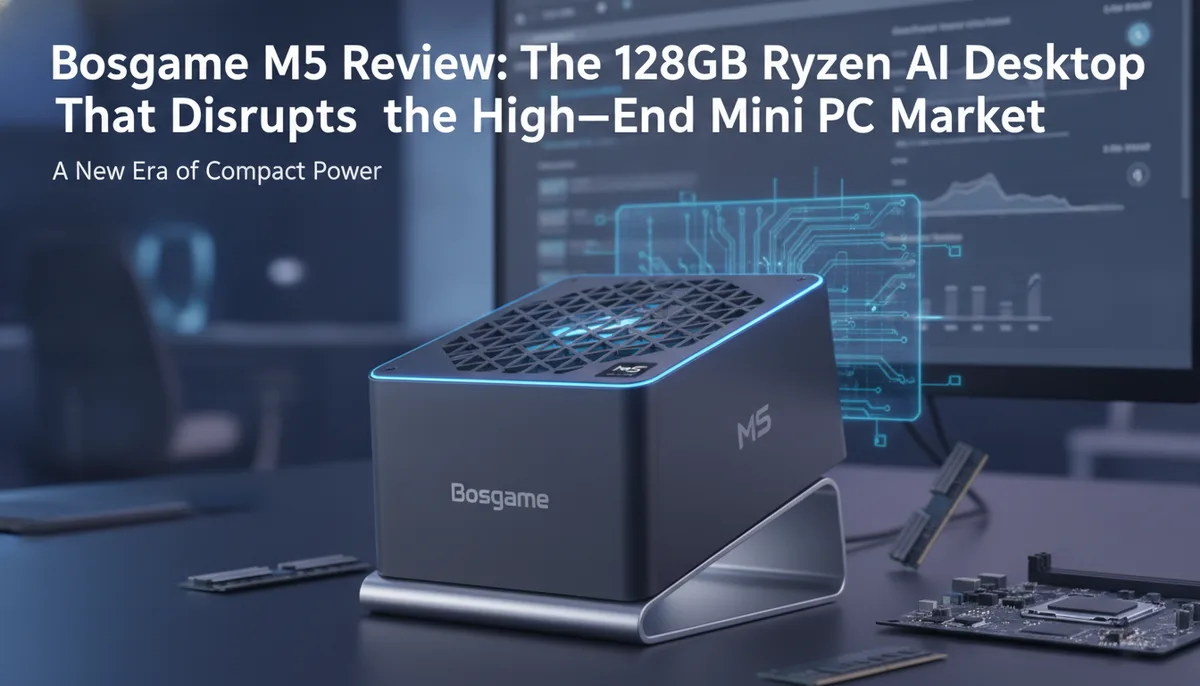
The Bosgame M5 doesn't look like your standard "gray box" mini PC. It features an aggressive, angled design that the STH studio team noted looks remarkably "cool." The chassis is designed with versatility in mind, including a sturdy metal stand for vertical mounting.
Visual Flair and Build Quality
One of the first things you notice is the integrated light strip. While RGB lighting is often polarizing, the implementation here is subtle and adds a modern aesthetic to the workspace. The front of the unit features overhanging edges that slightly recess the ports, providing a sleek, layered look.
Cooling Challenges
With a high-power processor like the Ryzen AI Max+ 395, heat is always a concern. Bosgame has addressed this with an aggressive vent design on the top and sides. One critical takeaway for users is the placement of these vents: because the top is a primary exhaust/intake area, you cannot stack other equipment on top of this unit without risking thermal throttling.
The bottom of the unit is equally interesting, featuring four large rubber feet. Curiously, two of these feet are placed on the angled sides. While they don't touch the desk in a standard horizontal orientation, they provide stability if the unit is tilted or moved.
Vertical Stand for Mini PC and Cooling Pads
Connectivity: The Good, the Bad, and the 2.5GbE
When it comes to I/O, the Bosgame M5 is surprisingly generous, especially when compared to some ultra-high-end systems like the NVIDIA DGX Spark or GB10 systems which can sometimes be surprisingly sparse on traditional ports.
Front-Facing Accessibility
The front panel is designed for the modern creator:
- USB4 Port: Essential for high-speed external storage or eGPU expansion.
- Two USB 3.2 Gen2 (10Gbps) Type-A Ports: Perfect for fast peripherals.
- SD Card Reader: A welcome addition for photographers and videographers, often missing in this segment.
- Audio Jack: A simple inclusion that is surprisingly absent on some competing "Halo" platforms.
Rear I/O and the Networking "Miss"
The rear panel continues the trend of high utility, offering an HDMI port, a DisplayPort, and another USB4 port. It also includes two USB 2.0 ports, which are ideal for keyboards, mice, or USB-to-serial converters used in networking labs.
However, the 2.5GbE Realtek LAN port is the one point of contention. In a machine with these specifications, a 10GbE port would have been more appropriate to match the high-speed nature of the rest of the hardware. If you require faster networking for moving massive AI datasets, you may need to look into an external solution like the XikeStor SKN-U310GT USB 10GbE NIC.
Performance Tuning: The Three-Mode Toggle
A unique feature of the Bosgame M5 is the physical performance mode button located on the front panel. This allows users to cycle through three distinct power profiles:
- Silent Mode: Lowers power consumption and fan noise, ideal for basic office tasks or media consumption.
- Balanced Mode: The default setting for general productivity.
- Performance Mode: Unlocks the higher power limits of the Ryzen AI Max+ 395, allowing the fans to ramp up to maintain maximum clock speeds during heavy AI workloads or rendering.
This hardware-level control is a significant advantage for users who want to switch between a quiet workstation during the day and a high-performance AI node at night.
USB 10GbE Ethernet Adapter Realtek RTL8159
Is the Bosgame M5 the Ultimate Family Cloud Server?
When evaluating a system for "The Family Cloud," we look for longevity, capacity, and versatility. The Bosgame M5 hits all three marks. Its 128GB of RAM ensures that as AI models grow in size and complexity, this machine won't become obsolete in twelve months.
Whether you are running a local instance of a Large Language Model for private family assistance, or using it as a high-end media transcoding server, the M5 has the overhead to handle it. It bridges the gap between consumer-grade mini PCs and professional workstations. While it may lack the multi-screen novelty of something like the KYY X90G Quad, it focuses its resources where they matter most: raw computational throughput and massive memory.
Final Thoughts on Value
The core value proposition of the Bosgame M5 is impossible to ignore. By offering the same silicon and memory capacity as the most expensive "Strix Halo" machines on the market for up to $1,100 less, Bosgame has created a "value king" in the high-end segment. While the 2.5GbE port is a slight disappointment, the overall package—from the cool aesthetics to the massive 128GB of LPDDR5X—makes it a top contender for anyone serious about local AI.
If you are looking for a machine that can grow with the rapidly evolving AI landscape without breaking the bank, the Bosgame M5 is a rare find that balances extreme specs with a surprisingly accessible price point.