
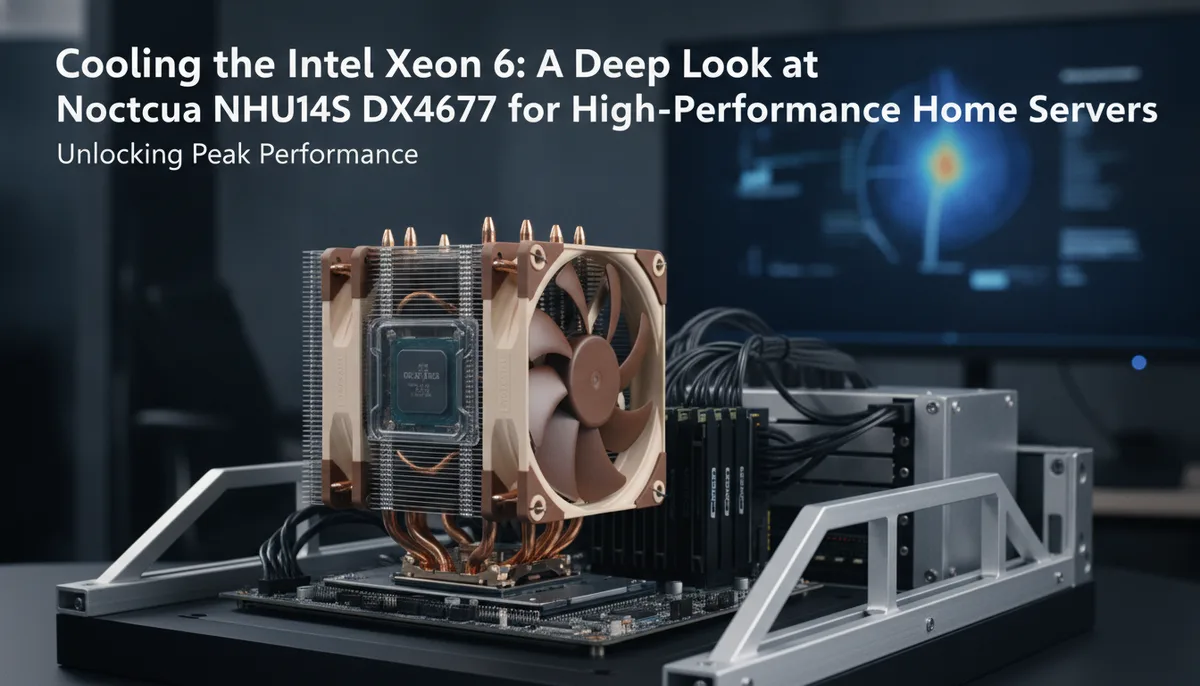
Cooling the Intel Xeon 6: A Deep Look at the Noctua NH-U14S DX4677 for High-Performance Home Servers
The landscape of high-performance computing is shifting rapidly. As families and professionals look to move their data away from public clouds and toward private, localized solutions, the hardware required to power these "Family Clouds" has become increasingly sophisticated. When you are building a machine capable of handling local AI LLMs, massive photo indexing, or high-end video rendering, you often find yourself looking at enterprise-grade silicon.
Recently, the Intel Xeon 6 series has emerged as a powerhouse for these applications. Specifically, the Intel Xeon 658X, a 250W beast, offers the kind of multi-threaded performance that can redefine what a home server is capable of. However, 250W of thermal design power (TDP) presents a significant challenge: how do you keep a server-grade processor cool without making your home office sound like a jet engine?
Enter the Noctua NH-U14S DX4677. This heatsink is a specialized evolution of one of the most respected cooling platforms in the industry, specifically tailored for the latest generations of Intel Xeon processors.
The Challenge of Cooling the Intel Xeon 658X
The Intel Xeon 658X is not your average consumer CPU. While many home users are accustomed to the LGA1700 or AM5 sockets found in gaming rigs, the Xeon 6 series utilizes larger, more complex mounting systems. The 658X specifically uses the LGA4710 mounting.
Cooling a 250W processor requires more than just raw surface area; it requires precision in how that heat is transferred from the integrated heat spreader (IHS) to the cooling fins. For those following our The Family Cloud Master Buying Guide: Secure Your Memories with a Private Home AI Server, you know that stability is the cornerstone of any private data solution. Thermal throttling on a server can lead to sluggish performance during critical data backups or AI training sessions.
The NH-U14S DX4677 is designed to meet this challenge head-on. It is effectively a customized version of Noctua’s NH-U14S, modified with a significantly larger contact plate. This larger base is essential to cover the massive surface area of the Intel Xeon Sapphire Rapids, Emerald Rapids, and the new Xeon 6 series (specifically the smaller socket variants, excluding the massive 6900E+ or 6900P series).
Unboxing and First Impressions: The Noctua Standard
Noctua has built a reputation not just on performance, but on the "out-of-box" experience. The NH-U14S DX4677 arrives in the classic Noctua brown and white packaging, emphasizing function over flash.
Inside, the unit comes with the heatsink and two NF-A15 140mm PWM fans already assembled. While this looks impressive immediately, it is important to note that installation actually requires a bit of disassembly. To secure the heatsink to the motherboard, the fans must be removed to access the mounting screws, then reattached once the block is seated.
One of the most appreciated features for professionals is the inclusion of pre-applied thermal interface material (TIM). In high-stakes environments—or even in a home lab where you might be swapping components—having the TIM pre-applied ensures a perfectly even spread across the large Xeon IHS. We have previously noted in other hardware looks how much we prefer this "ready-to-go" approach for workstation units.
Engineering for Silence and Performance
The "DX4677" designation in the name refers to its primary compatibility with the LGA4677 socket, but its versatility extends to the LGA4710 used by the Xeon 658X. The secret to its performance lies in the combination of six heatpipes and the dual-fan configuration.
The NF-A15 140mm PWM Fans
The NH-U14S DX4677 utilizes two NF-A15 fans in a push-pull configuration. These are 140mm fans with a round frame that features 120mm mounting holes. This design allows for a larger blade surface area, which translates to higher airflow and static pressure at lower RPMs.
For a "Family Cloud" server that might live in a closet, a basement, or even a home office, noise is a critical factor. While server-grade blowers are effective, they are notoriously loud. Noctua’s fans allow the Xeon 658X to run at full tilt while keeping the acoustic profile low enough for a residential environment. This makes it an ideal companion for high-capacity storage builds, such as those discussed in our guide on the Best Home Servers for Storing 10 Years of Family Photos (and Keeping Them Private).
The Large Contact Plate
Standard consumer coolers often have contact plates that are too small for the rectangular, elongated dies of modern Xeon processors. If the cooler doesn't cover the entire IHS, "hot spots" can develop, leading to uneven thermal expansion and potential stability issues. The NH-U14S DX4677 features a massive, nickel-plated copper base specifically sized for these enterprise chips, ensuring that every watt of heat produced by the 250W 658X is efficiently moved into the heatpipe array.
Installation Nuances: The Carrier Frame
It is vital for builders to understand that the heatsink is only one part of the equation. For the Intel Xeon 6 series and the LGA4710 socket, you must have the correct carrier frame. The processor is first snapped into the carrier frame, and then the frame/CPU assembly is attached to the heatsink before the entire stack is lowered onto the socket.
Noctua includes a specialized tool in the box to assist with this process. This attention to detail is what separates workstation-class cooling from generic solutions. The inclusion of a Y-cable for the fans also ensures that both NF-A15 fans can be controlled via a single PWM header on the motherboard, allowing for synchronized speed ramping based on the CPU temperature.
Why This Matters for the Private Data Center
When we talk about "The Family Cloud," we are talking about moving away from the convenience of big-tech subscriptions toward the sovereignty of home-hosted data. This transition often requires hardware that can handle intense workloads—like the Micron 9650 PCIe Gen6 SSDs that redefine data caching speeds.
A processor like the Xeon 658X provides the PCIe lanes and the raw compute needed to manage these high-speed storage arrays and AI workloads. However, that power is wasted if the system is constantly throttling due to heat. The Noctua NH-U14S DX4677 provides the thermal headroom necessary to let these components run at their rated speeds for hours or days at a time.
Final Thoughts: A Reliable Foundation
The Noctua NH-U14S DX4677 is not a flashy component. It doesn't have RGB lighting or an OLED screen. Instead, it offers something much more valuable for the serious home server builder: reliability and silence.
For those deploying the Intel Xeon 6 series in a workstation or a high-end home server, this heatsink is arguably the best air-cooling option on the market. It bridges the gap between the extreme cooling needs of enterprise silicon and the acoustic requirements of a home environment.
Whether you are building a powerhouse for AI or a secure vault for a decade of family memories, the foundation of that system is its stability. By choosing a cooling solution that is specifically engineered for the LGA4710 socket and the 250W demands of the Xeon 6 series, you are ensuring that your "Family Cloud" remains online, efficient, and quiet for years to come.