
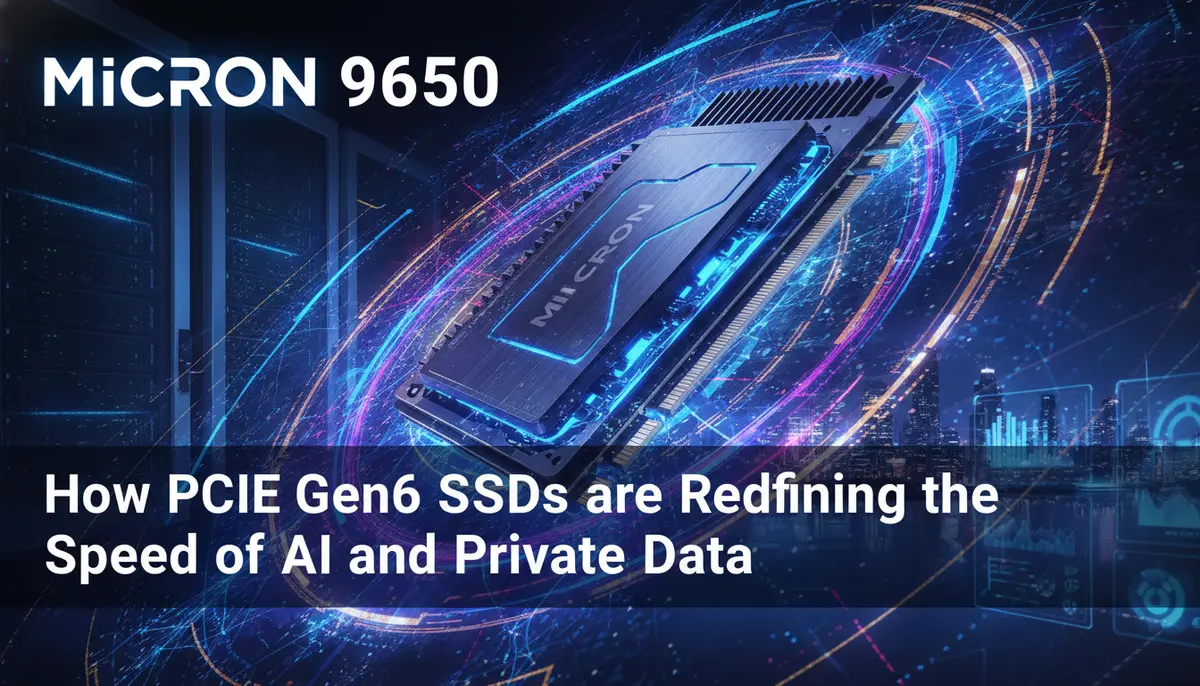
Micron 9650: How PCIe Gen6 SSDs are Redefining the Speed of AI and Private Data
The global semiconductor landscape is currently defined by a high-stakes race for bandwidth. With industry-wide DRAM and NAND shortages creating a seller's market, memory vendors are under immense pressure to deliver hardware that can keep pace with the insatiable appetite of Artificial Intelligence (AI). At the forefront of this evolution is Micron, which recently unveiled the 9650 enterprise SSD—the company’s first foray into the PCIe Gen6 ecosystem.
While enterprise hardware often feels removed from the average consumer’s daily life, the innovations found in the Micron 9650 represent the blueprint for the next decade of data management. For those of us building a The Family Cloud Master Buying Guide: Secure Your Memories with a Private Home AI Server, understanding these shifts is essential to future-proofing our personal digital legacies.
The Dawn of the PCIe Gen6 Era
The jump from PCIe Gen5 to Gen6 is more than just a numerical increment; it is a fundamental shift in how data moves through a system. PCIe Gen6 doubles the bandwidth of its predecessor, utilizing PAM4 (Pulse Amplitude Modulation 4-level) signaling to achieve higher data rates. Micron is capitalizing on this transition by aiming for the absolute ceiling of the specification.
The Micron 9650 is rated for sequential read speeds of up to 28GB/second. To put that in perspective, a standard high-end consumer Gen4 drive usually tops out around 7.5GB/second. By saturating a PCIe Gen6 x4 link right out of the gate, Micron is providing the "highway" necessary for AI clusters to communicate without the storage bottleneck that has plagued previous generations.
Why 28GB/s Matters for AI Training
In the world of AI, speed isn't just about convenience; it’s about viability. Large Language Models (LLMs) and complex neural networks require massive datasets to be fed into GPUs at lightning speeds. If the storage cannot keep up, the GPUs—which cost tens of thousands of dollars—sit idle. Micron’s 5.5 million IOPS (Input/Output Operations Per Second) for random reads ensures that the "small" data points required for inference are delivered as efficiently as the large sequential blocks.
Breaking Down the Micron 9650 Specs
Under the hood, the 9650 is a masterclass in vertical integration. Micron has paired their new proprietary PCIe Gen6 controller with their ninth-generation (G9) TLC NAND. This G9 NAND is already proving its worth in other Micron products, but when married to the Gen6 controller, it reaches its full potential.
Read-Optimized vs. Mixed Workload
Micron is launching the 9650 in two primary configurations to suit different data center needs:
- The 9650 PRO: Designed for read-intensive workloads, such as AI inference and content delivery networks. These drives offer the highest capacities, reaching up to 30.72TB.
- The 9650 MAX: Optimized for mixed workloads where write endurance is more critical. These drives top out at 25.6TB, providing a buffer for the high-frequency writes common in transaction-heavy databases.
While the read speeds are the headline act at 28GB/s, the write performance is more conservative. Sequential writes are rated at 14GB/second, and random writes sit at 900K IOPS. This confirms that the 9650 is a precision tool built specifically for the "read-heavy" nature of modern AI model weights.
The Cooling Challenge: Why Liquid Cooling is the New Standard
One of the most striking revelations regarding the Micron 9650 is its thermal requirements. High-performance computing generates heat, and at a 25-Watt power envelope, the 9650 pushes the limits of traditional air cooling.
For the first time, Micron is indicating that for its smallest form factor—the E1.S configuration—liquid cooling is not just an option, but a necessity. Micron describes the E1.S drive as "optimized" for liquid-cooled environments. This is a direct response to the design of modern AI servers, where high-density GPU clusters are already moving toward direct-to-chip liquid cooling to maintain stability.
For enthusiasts and home server builders, this serves as a warning. As we move toward faster local storage to support private AI, thermal management will become a primary design consideration. Even today's Gen5 consumer drives often require massive heatsinks or active fans to prevent thermal throttling.
From Data Center to Living Room: The Trickle-Down Effect
It is easy to look at a 30TB enterprise drive and think it has no relevance to a home setup. However, the technology pioneered in the 9650 will eventually dictate the standards for the Best Home Servers for Storing 10 Years of Family Photos (and Keeping Them Private).
The Local AI Revolution
As privacy concerns grow, more families are looking to run local AI models for photo organization, facial recognition, and private digital assistants. These models require high-speed access to "weights"—the data that tells the AI how to think. The faster the SSD, the more "instant" your private AI feels. Micron’s focus on the AI inference market with the 9650 is a harbinger of the hardware we will eventually want in our closets and home offices.
Durability and Longevity
Enterprise drives like the 9650 are built for 24/7 operation under intense stress. While a home user may not need 28GB/s, the NAND technology (like Micron's G9 TLC) ensures that our family photos remain bit-perfect for decades. Investing in enterprise-grade storage technology—even if it's a generation behind the bleeding edge—is often the best way to ensure data integrity.
The Waiting Game: Platform Availability
Despite mass production having already begun, you won't see the Micron 9650 in a retail server tomorrow. The hardware is currently ahead of the infrastructure. At present, there are no publicly available, shipping server platforms that feature native PCIe Gen6 connectivity.
The roadmap for Gen6 looks like this:
- Intel: The Xeon 7 "Diamond Rapids" platform is expected to be a primary vehicle for Gen6 adoption.
- NVIDIA and AMD: Both giants appear to be targeting 2027 for a wide-scale rollout of Gen6-compatible AI infrastructure.
- Hyperscalers: Custom designs from Google, Amazon, and Meta, along with Arm-based AGI CPU designs, are expected to be the first to utilize these drives in the coming quarters.
This gap between drive availability and platform support is common in the enterprise world. It allows data center architects to validate the storage hardware so that when the CPUs and GPUs finally arrive, the ecosystem is stable and ready for deployment.
Future-Proofing Your Personal Data Strategy
While we wait for PCIe Gen6 to become a reality for the prosumer market, there are practical steps you can take today to align with where the industry is heading:
- Prioritize Read Speed for AI: If you are building a local AI server, look for drives with high random read IOPS. This matters more for model responsiveness than sequential write speeds.
- Invest in Cooling: If you are upgrading to PCIe Gen5 today, do not skimp on cooling. The 25W power draw of the Micron 9650 proves that the industry is willing to trade power for performance, and heat is the inevitable byproduct.
- Watch the Enterprise Market: As the 9650 rolls out, older Gen4 and Gen5 enterprise drives often hit the secondary market at significant discounts. These drives offer incredible reliability for home servers.
The Micron 9650 is a testament to the fact that we are no longer just "storing" data; we are "powering" it. Whether it's a massive data center training the next global LLM or a small home server indexing a decade of family memories, the speed at which we can access our digital lives is about to take a quantum leap forward.
For more insights on how to manage your local data with the latest technology, check out our guide on Is Your Smart Camera Spying on You? Why Parents Are Switching to Local Storage.