
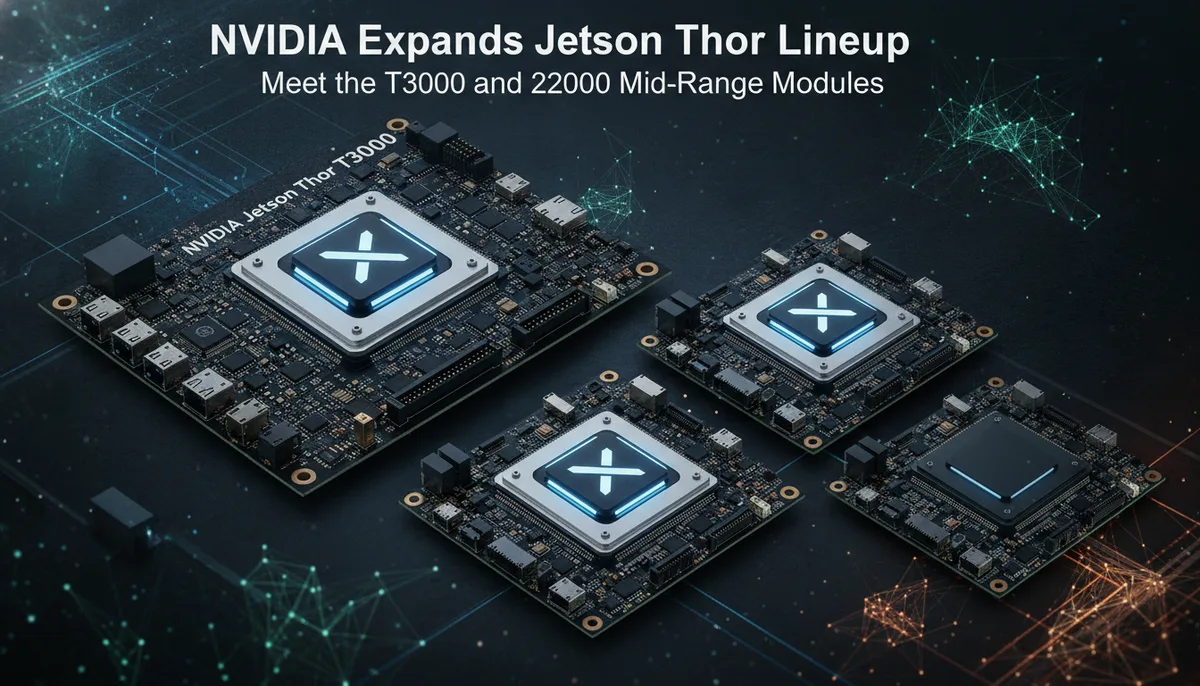
NVIDIA Expands Jetson Thor Lineup: Meet the T3000 and T2000 Mid-Range Modules
The Shift Toward Accessible Edge AI
For years, the "Cloud" has been the undisputed king of artificial intelligence. However, as privacy concerns grow and latency requirements become more stringent, the industry is seeing a massive shift toward "Edge AI"—processing data locally on hardware you own. NVIDIA’s Jetson platform has long been the gold standard for this movement, and the recent announcement of the Jetson Thor T3000 and T2000 modules marks a pivotal moment for both industrial developers and high-end home server enthusiasts.
Originally, the Jetson Thor was positioned as a high-performance powerhouse designed to fuel the next generation of humanoid robots. But power often comes with a prohibitive price tag. By introducing these two mid-range boards, slated for a Q1 2027 release, NVIDIA is signaling that the future of AI isn't just for billion-dollar corporations; it’s becoming increasingly viable for the private data centers we maintain in our own homes.
Understanding the Jetson Thor Architecture
To appreciate the T3000 and T2000, one must first understand the foundation they are built upon. The Jetson Thor lineup utilizes NVIDIA’s Blackwell GPU architecture. This is the same underlying technology found in the world’s most powerful data center GPUs, optimized for the power envelopes required at the "edge" (your home or office).
Thor modules are designed to handle "World Models"—complex AI systems that allow machines to understand and interact with physical environments. For the user building a The Family Cloud Master Buying Guide: Secure Your Memories with a Private Home AI Server, this means the ability to run local Large Language Models (LLMs) and advanced computer vision tasks with unprecedented efficiency.
Key Features of the Thor Platform:
- Blackwell GPU: High-performance tensor cores for AI inference.
- ARM Neoverse CPU: Multi-core processing power to handle general-purpose computing tasks alongside AI workloads.
- Integrated Safety Clusters: Hardware-level features designed to ensure autonomous systems operate safely.
The T3000 and T2000: Solving the Memory Cost Crisis
The primary driver behind the expansion of the Thor lineup is economic. In the current hardware climate, memory costs—specifically High Bandwidth Memory (HBM) and specialized LPDDR5X—have skyrocketed. This has placed immense pressure on developers who want the compute power of Thor but cannot justify the five-figure price tags of flagship modules.
The T3000 and T2000 are NVIDIA’s answer to this "memory pressure." While specific technical deep-dives on core counts are still forthcoming as we approach the 2027 launch, these modules are strategically designed to offer a "sweet spot" of performance.
- The T3000: Likely positioned as the high-mid-range option, offering enough VRAM and compute to handle multi-modal AI (text, image, and voice) without the extreme overhead of the flagship.
- The T2000: The entry-level Thor module, designed for high-efficiency tasks like real-time object detection and home automation management.
By diversifying the lineup, NVIDIA ensures that even if memory prices remain volatile, there is a tier of hardware that fits the budget of small-scale deployments and advanced home labs.
Why This Matters for Your Family Cloud
At The Family Cloud, we focus on how technology can protect and enhance your personal life. You might wonder why an industrial-grade AI module like the Jetson Thor T3000 belongs in a conversation about family photos and private data.
The answer lies in Local Intelligence. Most modern "smart" features—like searching your photo library for "the kids at the beach" or asking a voice assistant to summarize your family calendar—rely on sending your data to a corporate cloud. With a Jetson Thor-powered home server, that intelligence happens inside your four walls.
Practical Applications:
- Private Facial Recognition: Instead of Google or Apple "learning" your family's faces, a T2000 module can index 10 years of photos locally in a fraction of the time.
- Local AI Agents: Run a private version of an AI assistant that has access to your family's documents and schedules without ever uploading them to the internet.
- Next-Gen Security: Real-time analysis of home security feeds that can distinguish between a delivery driver and a stray animal without relying on a subscription service.
To support the massive data throughput these AI tasks require, pairing such a system with high-speed storage is essential. Technologies like the Micron 9650: How PCIe Gen6 SSDs are Redefining the Speed of AI and Private Data will be the perfect companions to the Thor lineup by the time 2027 rolls around.
Preparing for the 2027 Hardware Horizon
While Q1 2027 may seem distant, the roadmap for AI hardware is moving faster than ever. If you are planning to build or upgrade a home server, the announcement of the T3000 and T2000 should influence your long-term strategy.
Currently, many users rely on the Jetson Orin series. While Orin is incredibly capable, the jump to Blackwell architecture represents a generational leap in "AI per watt." If your goal is to build a Best Home Servers for Storing 10 Years of Family Photos (and Keeping Them Private), you should look for systems with modularity in mind.
For those who need a solution today, the Orin Nano remains a stellar entry point. However, keep an eye on carrier boards that might support the Thor pin-out in the future. NVIDIA has a history of maintaining some level of compatibility, though the power requirements for Thor will likely necessitate updated power delivery systems.
The Economic Impact: Why "Mid-Range" is the Real Winner
In the tech world, the "flagship" gets the headlines, but the "mid-range" does the work. By releasing the T3000 and T2000, NVIDIA is acknowledging that the "AI tax"—the premium paid for high-end silicon—needs to come down for mass adoption.
For the enterprise, this means more affordable fleets of warehouse robots. For the consumer, this means the technology eventually trickles down into high-end consumer NAS (Network Attached Storage) units and home automation hubs. The pressure of memory costs has forced NVIDIA to be creative, and that creativity results in more choices for the end-user.
Conclusion: A New Standard for Private AI
The announcement of the Jetson Thor T3000 and T2000 modules is more than just a spec update; it is a roadmap for the democratization of high-performance AI. By addressing the cost barriers of memory and offering a tiered approach to the Blackwell architecture, NVIDIA is ensuring that the next generation of "smart" technology can be owned, not just rented.
As we move toward 2027, the line between "industrial AI" and "home AI" will continue to blur. Whether you are a developer building the next humanoid robot or a parent looking to secure a decade of digital memories, the Jetson Thor expansion offers a glimpse into a future where powerful AI is accessible, affordable, and—most importantly—private.
Stay tuned to The Family Cloud as we continue to track the development of the Jetson Thor lineup and provide guides on how to integrate these powerful tools into your private digital life.