
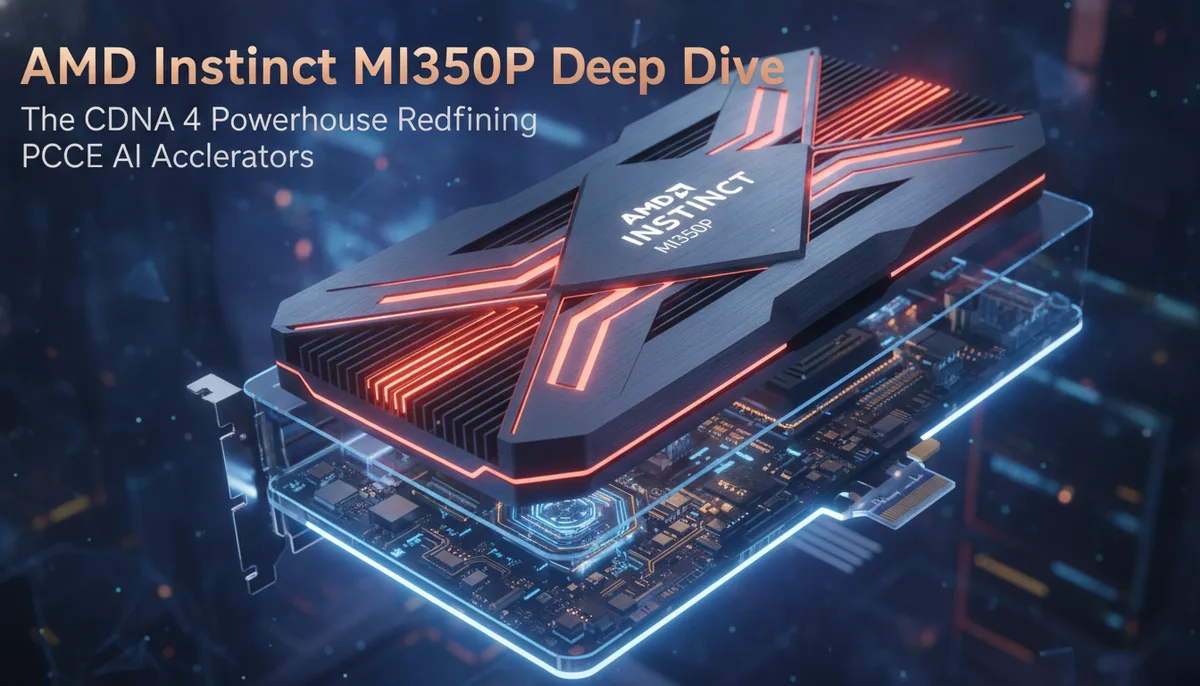
AMD Instinct MI350P Deep Dive: The CDNA 4 Powerhouse Redefining PCIe AI Accelerators
The landscape of enterprise AI hardware is shifting rapidly. While much of the industry's attention has been focused on massive OAM (Open Accelerator Infrastructure) modules and liquid-cooled server racks, a significant portion of the market still relies on the versatility of the PCIe form factor. At recent industry events like Dell Tech World, HPE Discover, and Computex 2026, the AMD Instinct MI350P has emerged as a primary contender for the title of the most capable PCIe-based AI accelerator on the market.
By bringing the CDNA 4 architecture to a standard PCIe card, AMD is addressing a critical gap: the need for massive memory capacity and high-bandwidth compute in systems that cannot accommodate the power or physical requirements of an OAM-based cluster. For organizations building out private AI infrastructure—similar to the concepts explored in The Family Cloud Master Buying Guide: Secure Your Memories with a Private Home AI Server—the MI350P represents the pinnacle of what can be achieved in a standard server slot.
The Memory Advantage: Why 141GB HBM3E Matters
In the world of Large Language Models (LLMs) and generative AI, memory is the ultimate currency. The ability to fit a model entirely within the VRAM of a single GPU—or a small cluster of GPUs—drastically reduces the latency caused by moving data across the PCIe bus or network.
The AMD Instinct MI350P enters the fray with a massive 141GB of HBM3E memory. When compared to its primary competitors, the strategic positioning becomes clear:
- NVIDIA H200 NVL: While the H200 NVL offers a slightly higher 144GB capacity, it is based on the older Hopper architecture.
- NVIDIA RTX Pro 6000 Blackwell Server Edition: This card utilizes the newer Blackwell architecture but is limited to 96GB of GDDR7 memory.
While GDDR7 is fast, it cannot compete with the sheer bandwidth provided by HBM3E. Furthermore, the 141GB capacity of the MI350P allows for significantly larger context windows and more complex model weights to reside on-card. For users who are transitioning from consumer-grade hardware to professional-grade AI servers, this jump in memory capacity is the single most impactful upgrade for inference performance.
CDNA 4 Architecture: Pushing the Boundaries of Precision
A spec sheet often tells only half the story. The real-world performance of the MI350P is driven by its support for advanced numeric formats. As AI researchers look for ways to squeeze more performance out of existing hardware, they have moved toward lower precision formats like FP6 and FP4.
The Rise of MXFP6 and FP4
The MI350P excels in these "narrow" numeric formats. While the Hopper generation (H100/H200) was designed before the industry-wide push for FP6 and FP4, the CDNA 4 architecture was built with these specifically in mind.
The inclusion of MXFP6 is a particular highlight. It acts as a "Goldilocks" format—offering better precision than FP4 while providing significantly higher throughput and lower memory footprints than FP8. By utilizing FP4 or FP6 for inference, developers can effectively double or triple the effective "capacity" of the card's memory, allowing models that would normally require multiple GPUs to run on a single MI350P.
Dense vs. Sparse Performance
It is important to note that AMD’s published figures focus heavily on dense performance. In the current AI landscape, many "peak" numbers provided by manufacturers are based on sparse workloads, which may not always reflect real-world LLM inference where dense computation is often the bottleneck. The MI350P's architectural focus on delivering high dense compute performance makes it a more predictable asset for enterprise deployments.
From OAM to PCIe: The MI350P vs. MI350X
One of the most common questions surrounding this new release is how it relates to the flagship MI350X. To understand the MI350P, you have to look at it as a carefully engineered "half-slice" of its larger sibling.
The MI350X is an OAM-based beast designed for massive AI factories. It consumes significant power and requires specialized chassis. AMD recognized that many customers need this level of performance in standard 2U or 4U rackmount servers. However, cramming a full MI350X onto a PCIe card is physically impossible due to the 600W power limit of the PCIe CEM form factor and the thermal constraints of air cooling.
The solution was the MI350P. By effectively using half of the compute and memory resources of the MI350X, AMD created a card that fits within a 600W TDP while still offering 141GB of HBM3E. This makes it a drop-in upgrade for modern AI-ready servers like the or the .
Video Processing and Multi-modal AI
Modern AI is no longer just about text. We are entering the era of multi-modal models that process images, audio, and high-definition video in real-time. This is where the MI350P’s video decoding capabilities become a strategic asset.
Unlike some specialized compute cards that neglect the media engine, the MI350P includes robust video decoding support. This is critical for applications such as:
- Real-time surveillance analytics: Processing dozens of 4K feeds simultaneously to detect anomalies.
- Automated video tagging: Indexing massive archives of family or corporate video content.
- Vision-Language Models (VLMs): Allowing the AI to "see" and describe video content in real-time.
For those managing large-scale media libraries, as discussed in our guide on Best Home Servers for Storing 10 Years of Family Photos (and Keeping Them Private), having a GPU that can both store the database and decode the video files locally is a massive efficiency gain.
Physical Design and Integration
The MI350P is a 600W passive-cooled card. This means it relies entirely on the high-static-pressure fans of the server chassis to move air through its cooling fins.
Design Characteristics:
- No Video Outputs: Like the NVIDIA H200 NVL, this is a "headless" card. It is designed for the data center, not for a workstation monitor.
- Front-Facing Power: The power connectors are located on the front of the card (the side opposite the I/O plate). This is standard for modern server GPUs to ensure cables do not interfere with the airflow from the server's mid-plane fans.
- Airflow Shroud: The card features a sleek, metallic shroud designed to maximize the velocity of air passing over the internal heatsinks.
When integrating these cards, power delivery is the primary concern. You will need a server equipped with high-wattage titanium-rated power supplies, such as the , though most enterprise users will utilize the integrated PDUs found in systems like those from AIC or Supermicro.
The Verdict: A New Standard for PCIe Inference?
The AMD Instinct MI350P is a clear signal that AMD is no longer content to play second fiddle in the AI hardware space. By prioritizing memory capacity and modern numeric formats, they have created a product that specifically targets the most painful bottlenecks in AI inference today.
While NVIDIA’s Blackwell architecture offers impressive theoretical peaks, the MI350P’s combination of 141GB of HBM3E and native support for FP4/FP6 makes it an incredibly compelling alternative for organizations that want to maximize their "tokens per dollar" without moving to proprietary OAM architectures.
For those building out high-end private clouds or enterprise inference clusters, the MI350P isn't just another option—it's a benchmark-setting accelerator that proves the PCIe form factor still has plenty of room to grow. If you are looking to house this kind of power in a dense storage environment, consider pairing it with a high-performance JBOF like the AIC F2032-01-G6: The 32-Bay JBOF Powerhouse for Next-Gen Private Data Caching to ensure your data pipeline can keep up with the GPU's massive appetite for information.